Cart
0
A sustainable home renovation doesn't have to mean a trip to a big-box store, a new credit card bill, or a pile of cardboard boxes heading to the recycling bin. The most eco-friendly home makeover you can do is the one that starts with what you already own.
Rearranging, refreshing, and repurposing beats buying new — for your wallet, for the planet, and honestly, for the character of your space. Manufactured furniture is designed to look the same. Your home shouldn't be.
Step 1: Do a "What Do I Actually Have?" Walk-Through
Before you move a single piece of furniture or add anything to a wishlist, do a proper inventory. Walk through every room slowly — and this time, look with intention.
Open storage doors. Pull out the items that have migrated to the back of closets, the inside of ottomans, or the corners of the basement. That lamp you relocated when you got the new couch. The wooden bowl you bought at a market three years ago. The stack of frames you keep meaning to hang.
As you go, ask yourself: Is this in the right room? Is it in the right spot? Does it serve the space — or is it just there because it's always been there?
Make quick notes in three categories:
-
Keep and use differently: Items with real potential that just need a better home, a different room, or a fresh context
-
Repair or refresh: Pieces that are worn, scratched, or tired but fundamentally good — candidates for paint, polish, or new hardware
-
Let go: Things that genuinely don't belong in your home anymore (these can be donated — more on that in a moment)
This step takes about an hour. It's also the most important one. You're gathering your raw materials before you spend a single dollar.
Step 2: Rearrange Before You Replace
The fastest, cheapest, and most sustainable home renovation technique? Move things around.
Most of us set up our furniture once — when we first moved in, under stress, carrying boxes — and never really revisit it. The result is a room arranged for convenience, not for living. Sofas pushed flat against walls. Lamps in the same corner for years. Art hung wherever a nail was already in the wall.
A fresh arrangement can completely transform how a space feels and functions. Here's how to approach it:
Swap pieces between rooms. The floor lamp gathering dust in your bedroom might be exactly what your reading corner needs. The side table crowding your hallway could anchor a living room vignette. Move things across the apartment before you decide they don't work.
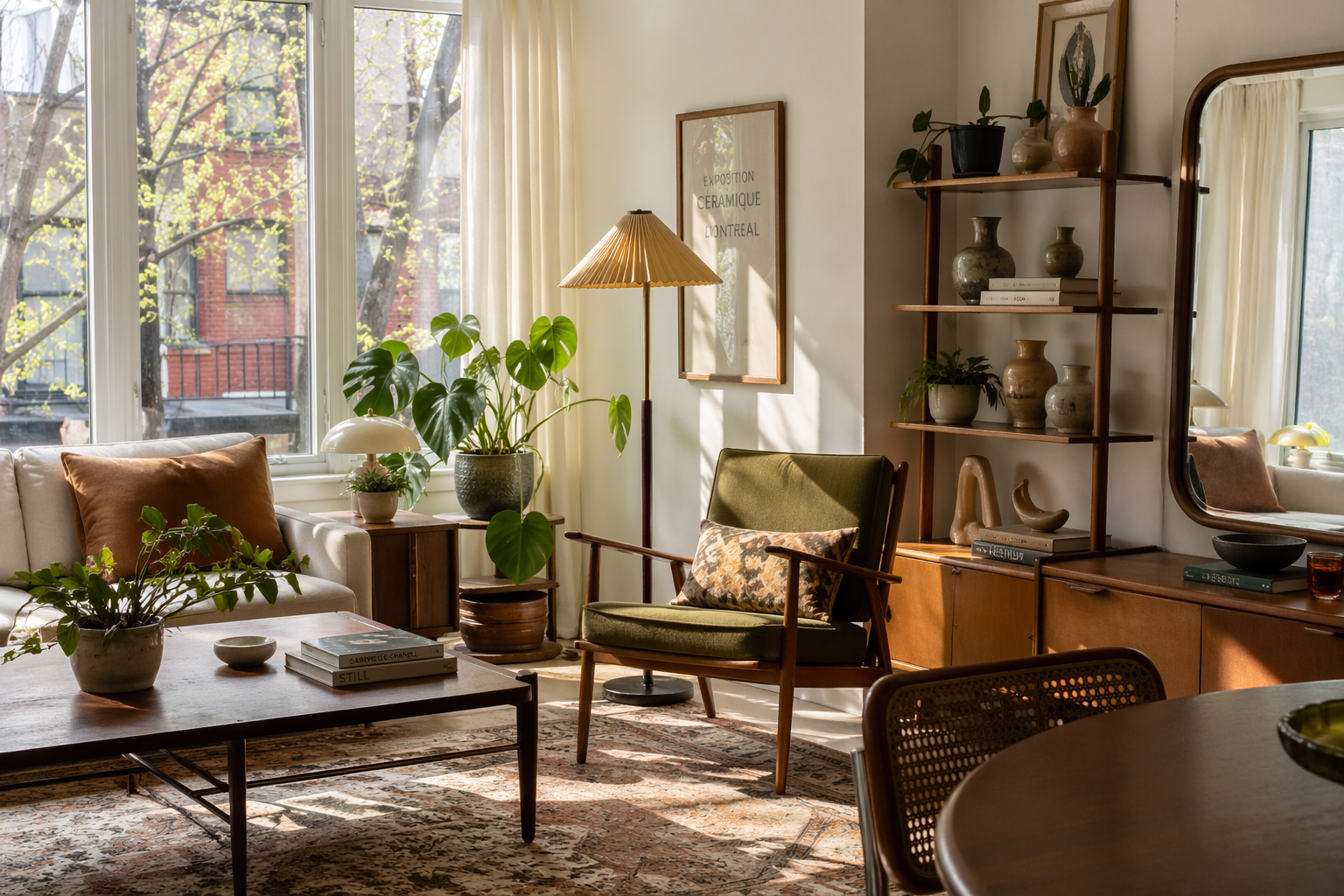
Float your furniture. Pull the sofa away from the wall by even 18 inches. Add a rug to define the zone. Suddenly the room feels intentional — like it was designed, not defaulted into. This is especially true in Plateau walk-ups and Mile End lofts where long, narrow rooms benefit enormously from furniture that creates distinct zones rather than lining the perimeter.
Rotate your art. The prints and pieces you love don't have to live in the same spot all year. Seasonal rotation keeps your walls feeling fresh and reminds you of pieces you'd started to overlook.
Change the light relationships. Where natural light falls in spring is different from winter. That east-facing window you covered in January to block cold drafts? Let it breathe now. Rearrange seating to catch the afternoon sun. Notice what the space becomes.
Quick tip: Before rearranging, take a photo of each room. The contrast between "before" and "after" is often startling — and makes it easier to go back if something doesn't work.
Step 3: Give What You Own a Second Act
This is where the real magic of a sustainable home renovation happens. You don't need new things. You need to look at what you have with fresh eyes.
Clean and polish first. This sounds obvious, but it's transformative. Brass that looks tarnished cleans up beautifully with a little lemon and baking soda. Wood that looks dull comes alive with a proper conditioning oil. Ceramic and glass pieces take on a completely different quality when they're actually clean. Before you decide something needs replacing, try giving it a proper refresh.
Paint a tired piece. A coat of matte black, warm white, or deep forest green can turn a scratched side table into a statement. Chalk paint adheres to almost anything without sanding — furniture, ceramic lamps, picture frames. You don't need to be a painter. One afternoon and $15 of paint can genuinely transform a piece.
"That 1970s side table you've been meaning to donate? Two coats of matte black paint and it's a conversation starter."
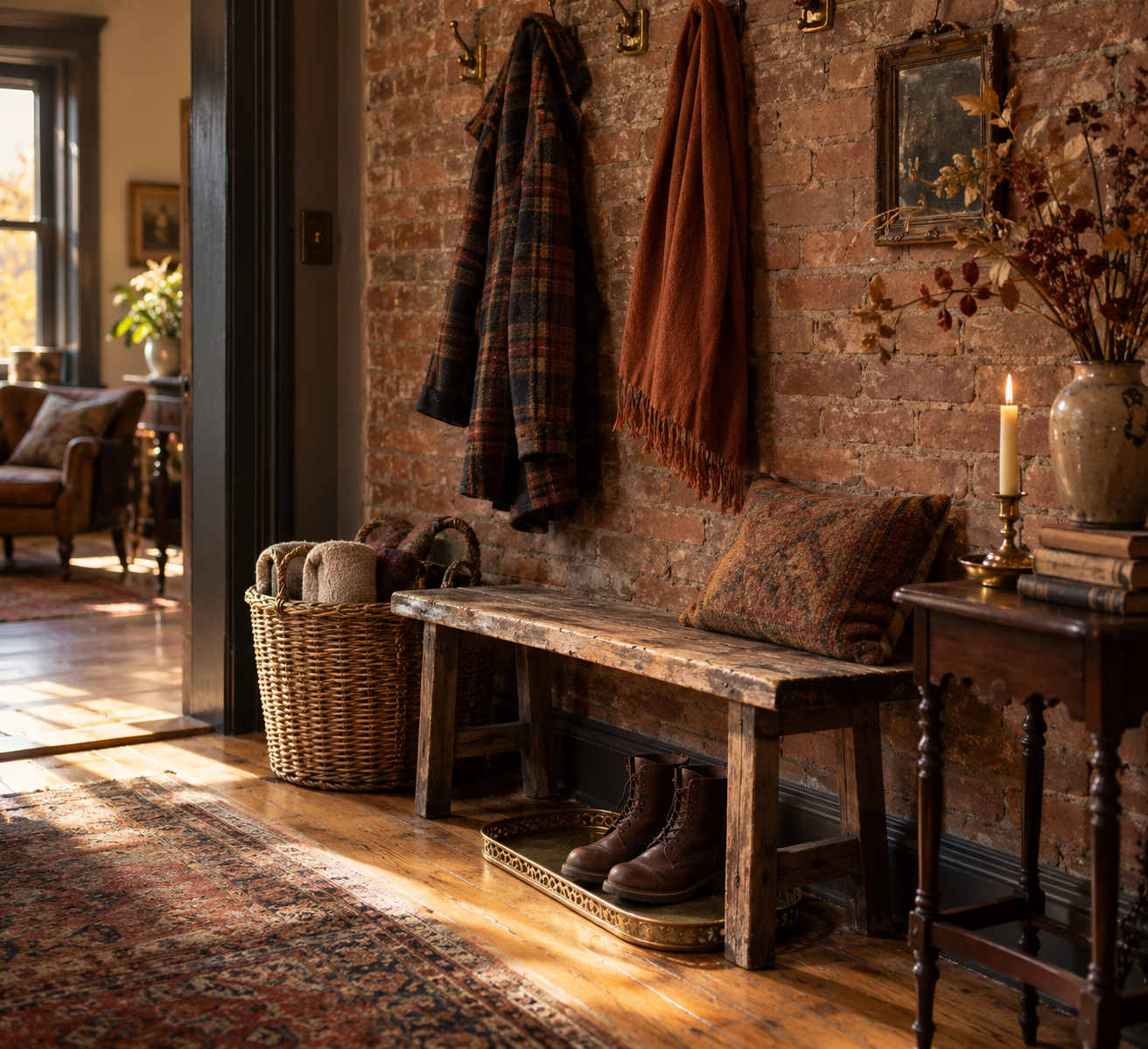
Swap out hardware. The fastest way to make a dresser, cabinet, or nightstand feel new: change the pulls. This takes 20 minutes and costs almost nothing if you source the hardware secondhand or repurpose something you already have (vintage coat hooks, old curtain rings, even leather loops work beautifully as drawer pulls).
Reupholster a single cushion. You don't have to redo an entire chair. A dining chair with a worn seat pad can be refreshed with a scrap of fabric from an old garment, a thrifted textile, or even a folded throw. A staple gun is all you need.
Frame what you already own. Fabric swatches, postcards, botanical prints cut from a calendar, a child's drawing, a vintage map, a piece of sheet music. Almost anything can become wall art when it's properly framed and displayed. Go through your drawers and shelves before buying a single print.
Step 4: Restyle Your Shelves and Surfaces
Restyling what's already on your shelves costs nothing and makes an enormous difference. The problem isn't usually what you have — it's how it's arranged.
Start by clearing everything off completely. This is important: don't just shuffle things around. Take it all down, wipe the surface clean, and start fresh.
Then rebuild with intention:
-
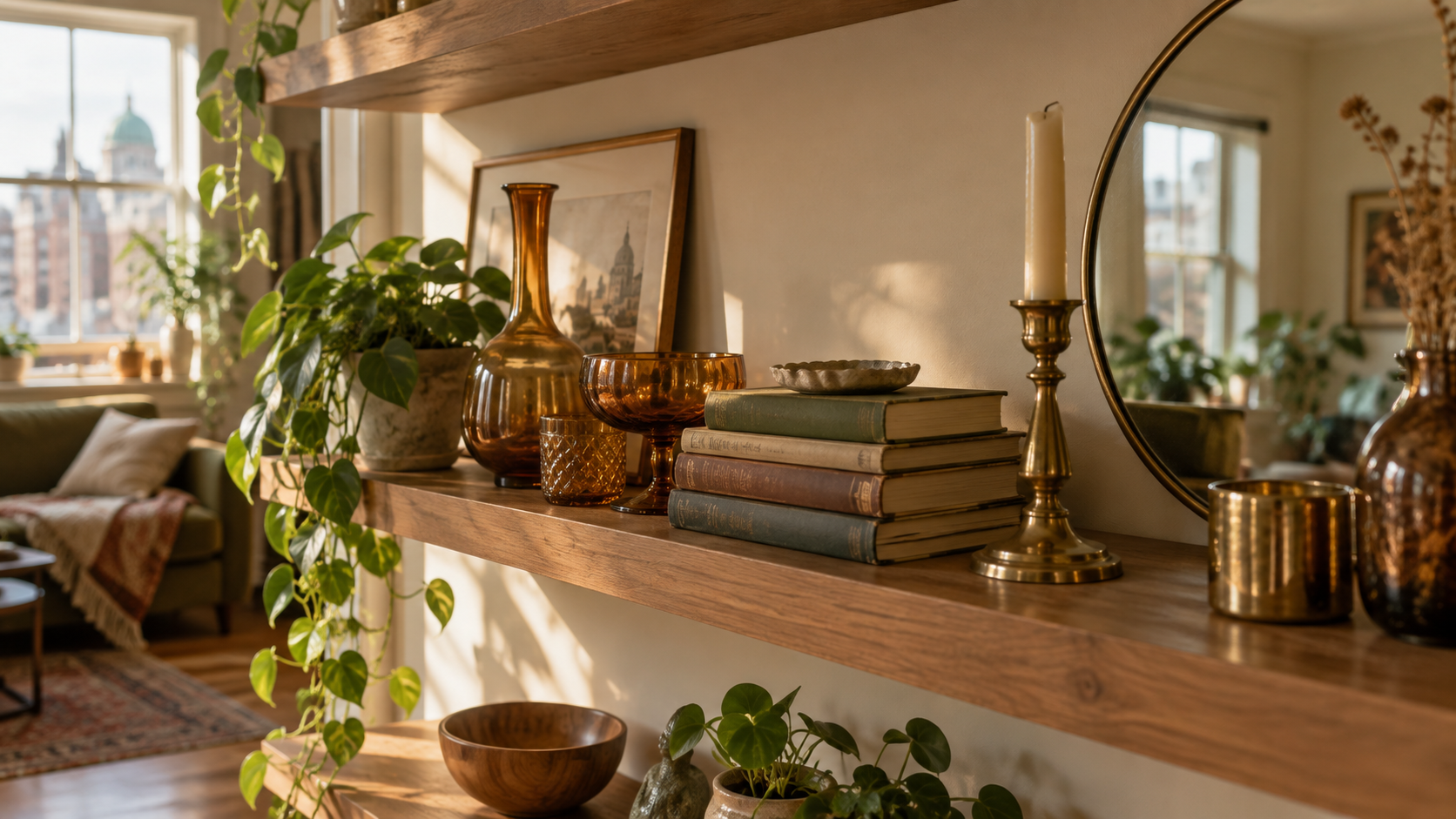
Group by material or colour rather than category — a cluster of warm-toned ceramics reads better than a random arrangement of "stuff"
-
Vary the heights — pair a tall lamp or vase with a low, wide object and something in between; flat arrangements feel static
-
Bring in natural elements — a handful of dried grasses, a branch of pussy willow from the Marché Jean-Talon, a few smooth stones from a walk in Parc Lafontaine add organic texture for free
-
Edit ruthlessly — this is the hardest step, but also the most important; a shelf with eight beautiful things looks intentional; a shelf with twenty-five things looks like storage
-
Try books spine-in for a neutral, gallery-style effect that lets objects do the visual work
The goal isn't a magazine cover. It's a surface that feels considered rather than accumulated.
Step 5: Let Light Do the Work
Lighting might be the single most underrated element of a home refresh — and moving lamps costs nothing.
Relocate your floor lamp. A floor lamp placed in a dark corner changes the entire character of a room. Pull it out from behind the sofa and aim it toward the ceiling for a warm ambient glow. Move the table lamp to the shelf. Try the desk lamp on the kitchen counter. Experiment freely.
Clean your light fixtures. Accumulated dust on a shade or fixture can reduce the warmth of a bulb dramatically. Clean fixtures — even just wiped down — immediately brighten a room.
Check your bulb temperatures. If you have spare bulbs in the closet, experiment. A warm 2700K bulb in the reading corner and a cooler 3000K bulb in the kitchen creates distinct zones that feel deliberate. This costs nothing if you already have the bulbs.
Add a mirror. A well-placed mirror doubles the natural light in a room, makes small spaces read larger, and adds visual depth. Thrifted mirrors — vintage frames, old dressing mirrors, ornate pieces with character — are one of EcoDepot's most consistent finds, and spring is a particularly good season for them. More on that below.
Step 6: When You Do Need Something New — Go Secondhand First
After doing all of the above, you'll likely find your "I still actually need this" list is much shorter than you expected. That's the point. A sustainable home renovation means buying less, not buying differently.
But when you do need something — a new lamp because the old one broke, a mirror for that wall, a rug to define your rearranged living room — secondhand should always be your first stop, not a fallback.
This shift is happening across Canada. 90 per cent of Canadian consumers have engaged with a thrift store through shopping, donating, or both — up from 83 per cent in 2022. And it's not just clothing: furniture (72%), kitchenware (74%), and home décor (70%) are among the top home categories Canadians say they would consider thrifting. The stigma is gone. Shopping secondhand for home items is simply the smart move.
Here's why it matters for a genuinely eco-friendly home makeover: every pre-loved piece you bring home is a piece that doesn't require new manufacturing, new shipping, new packaging, or new raw materials. The environmental cost of a product is largely incurred in its production — which means buying secondhand sidesteps almost all of it.
At EcoDepot Montreal, new inventory arrives every week — and spring is one of the best seasons to browse. As Montrealers declutter and move, a steady stream of quality pieces finds its way onto our shelves: vintage lamps, decorative mirrors, ceramic objects, rugs, frames, small furniture, and occasional designer finds that have no business being priced the way they are.
When you shop with a list — and the measurements you took during your walk-through — secondhand shopping becomes focused and satisfying rather than overwhelming. You know what you need. You know the dimensions. You know the room. Now you just need the right trouvaille.
The Best Spring Refresh Starts With What You Already Have
A sustainable home renovation isn't a project you have to buy your way through. The most meaningful transformations come from looking at your own space with new eyes — seeing the potential in a forgotten piece, the possibility in a rearranged room, the character in something worn and real.
When spring arrives in Montreal, resist the reflex to shop. Walk through your apartment first. Move the lamp. Paint the side table. Restyle the shelf. Take stock of what you actually have before adding anything new.
And when the moment comes — when you've rearranged, upcycled, and restyled and there's still one thing genuinely missing — EcoDepot Montreal should be your first stop. With weekly new arrivals, a curated selection across furniture, lighting, mirrors, ceramics, textiles, and more, and two locations in Lachine and on the Plateau, your next great find is probably already waiting. Come explore in person or follow us on Instagram @ecodepotmontreal to see what just came in.
Your space doesn't need to be new to feel new. It just needs a little attention — and maybe one good trouvaille.