Cart
0
Every object in your home has a biography. The lamp on your nightstand. The ceramic bowl on your kitchen shelf. The chair that gets used every single day. Each one started somewhere, traveled somewhere, and eventually ended up with you. But for most things we buy new, that biography is short — and not particularly inspiring.
Made in a factory. Shipped across an ocean. Purchased. Replaced. Discarded.
Thrift store shopping — real thrift store shopping, the kind you find in Montreal's neighbourhoods — breaks that cycle entirely. It's where objects get a second chapter. A rebirth. And understanding that journey changes how you see every pre-loved piece you bring home.
In this article, we'll trace the full life of an object: from factory floor to donation bin to a curated shelf at a thrift store in Montreal, and finally, into your home. By the end, you'll see sustainable home items not as compromises — but as the richer, smarter, more beautiful choice.
The First Life — How Objects Are Born (and Abandoned)
Before we talk about second lives, let's look honestly at first ones.
Most of the furniture and home goods available at major retailers today belong to a category that's quietly become known as "fast furniture" — items manufactured rapidly and inexpensively, designed to be accessible now and replaced soon. They're made from particle board, laminate, MDF, and synthetic materials. They're produced with an environmental cost that's largely invisible to buyers: resource extraction, manufacturing emissions, chemical treatments, and thousands of kilometres of shipping, all before the item ever reaches a shelf.
This is what's called embodied carbon — the total environmental footprint already baked into an object by the time it reaches you. For a brand-new sofa or bookshelf, that number is substantial, even before you consider what happens when it breaks or goes out of style.
And here's the hard truth: most of these items are discarded within a few years of purchase. They're not designed to last. Joints loosen. Surfaces chip. Trends shift. Into the landfill they go — and the cycle repeats.
Choosing secondhand doesn't just save you money. It means that embodied carbon is already spent — no new extraction required. The environmental heavy lifting has already been done, decades ago, by an object that was built to last.
What Is the Circular Economy — and Why Thrift Stores Are at Its Heart
You've probably heard the term "circular economy" — but what does it actually mean in practice, especially when you're standing in front of a shelf of vintage ceramics?
The conventional economic model is linear: extract raw materials, manufacture a product, use it, throw it away. The circular economy asks a different question: what if nothing had to be wasted? What if every product, at the end of its useful life with one owner, could find its way to another?
Thrift stores are the physical infrastructure that makes this possible. They're the places where the loop closes. When someone donates a lamp, a chair, or a set of dishes, those items re-enter circulation rather than heading to a landfill. When you buy them, you complete that loop.
Montreal is well positioned at the forefront of this shift. The city's identity — creative, community-rooted, proudly independent — maps naturally onto thrift culture. Shopping secondhand here isn't a compromise. It's a statement about the kind of city you want to live in.
The Journey of an Object — A Story in Three Acts
Let's make this concrete. Imagine a mid-century teak credenza — the kind built in Denmark in the late 1960s, all solid wood joinery and clean lines.
Act 1 — Made: It was crafted by hand. The wood was cut from a single solid piece — no particle board, no laminate. The hardware was solid brass. The person who built it expected it to last a lifetime. It did.
Act 2 — The In-Between: Decades pass. Families change. Someone decides it's time to let it go. It arrives at a place like EcoDepot Montreal — assessed, cleaned, and placed where it can be found again. Not thrown away. Not forgotten. Simply waiting.
Act 3 — Discovered: You walk in on a Tuesday. You almost miss it, tucked near the back. But the wood grain catches the light, and you stop. You pull out a drawer. Smooth glide. Solid frame. You check the price tag and you can't quite believe it.
That's not just furniture. That's a trouvaille — a real find. And that credenza, built to survive a century, will now survive another.
This is what happens at a thrift store in Montreal every single week. Objects arrive with stories and leave with new ones.
Why Sustainable Home Items From a Thrift Store Are Often Better Quality
Here's something that often surprises first-time thrifters: the quality of older pieces frequently exceeds anything available at the same price point today — and often exceeds what's available at much higher price points.
Pre-1980s manufacturing standards were built around durability. Furniture was made from solid wood, real metal, and thick glass. Ceramics were fired properly. Lamps were wired to last. Manufacturers assumed their products would be in use for decades because they were designed for people who expected things to last.
Compare that to today's mass-produced alternatives: pressed wood that swells at the first sign of moisture, finishes that chip with daily use, plastic components that crack after a few years. The irony is that a vintage piece — one that has already survived 40 or 50 years — has proven its durability in a way that no new item can claim.
There's another dimension to this as well: off-gassing. New furniture and home goods made from particle board, synthetic adhesives, and chemical finishes release volatile organic compounds (VOCs) into your home for months or even years after purchase. Vintage items have had decades to off-gas. They're not just better for the planet — they're often healthier for your home.
Some categories where this quality gap is especially clear:
Furniture: Teak, oak, and walnut pieces from mid-century Scandinavian or Italian manufacturers were built before flat-pack dominated. Joints are mortise-and-tenon, not cam locks.
Lighting: Vintage fixtures — and occasional designer pieces like Artemide lamps — are wired with quality components and built with materials that age beautifully.
Kitchenware: Cast iron, Pyrex, and vintage ceramic pieces were made to withstand daily use across generations. They're often safer and more durable than modern equivalents.
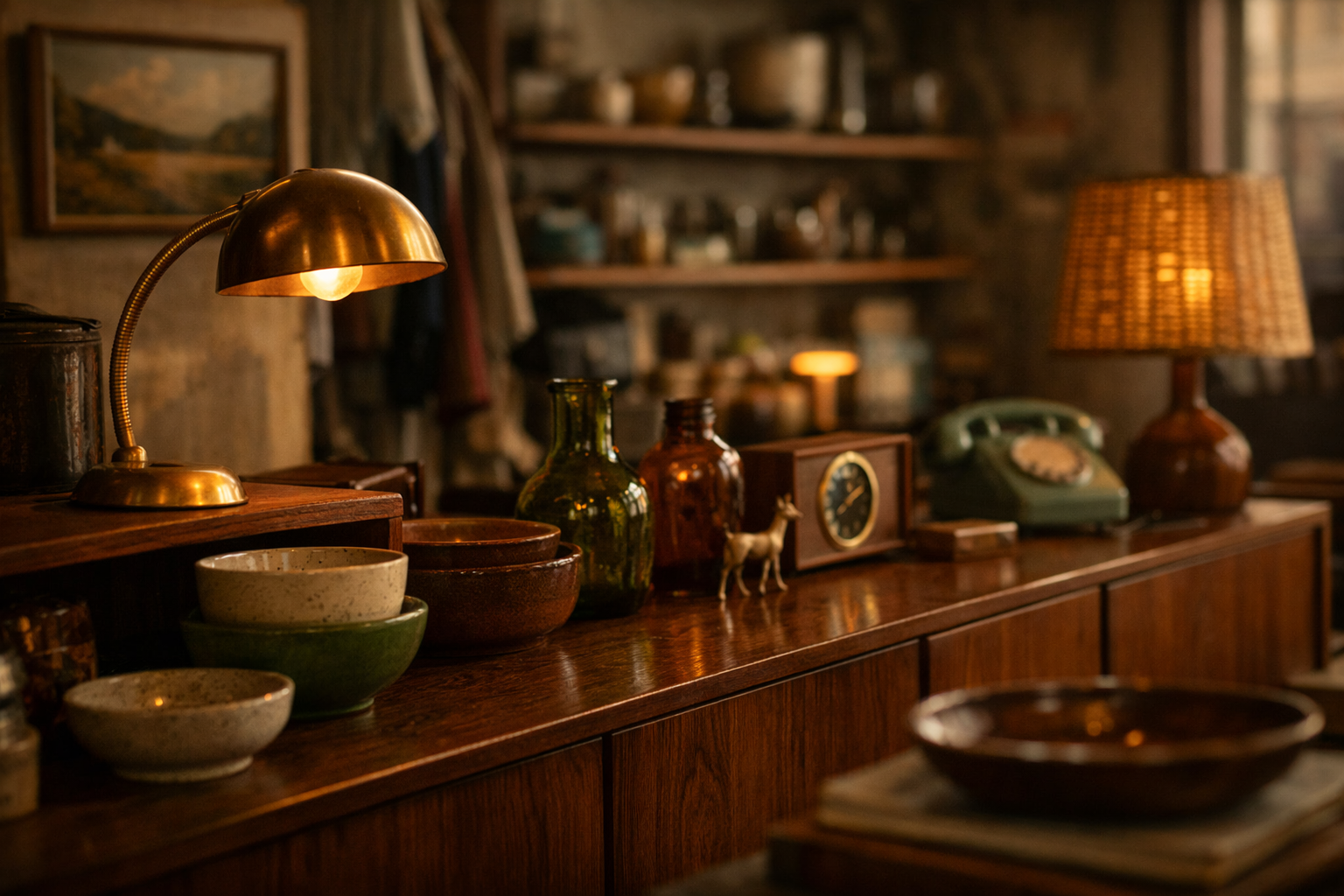
Décor: Brass, ceramic, and glass pieces develop patina over time. That patina isn't wear — it's character that no new piece can replicate.
The Montreal Angle — Thrift Culture in Our City
There's something particular about thrift culture in Montreal. It fits here in a way that feels organic, not trendy.
This is a city that prizes creativity, individuality, and a certain resistance to the generic. The neighbourhoods — Plateau, Mile End, Rosemont, Verdun, Lachine — each have their own character, and residents tend to want their homes to reflect that. Mass-produced furniture from a big-box store doesn't do that. A 1970s Italian lamp or a hand-thrown ceramic bowl does.
Montreal's bilingual, multicultural character also shapes its thrift culture. Shopping secondhand here is genuinely democratic — it doesn't require a big budget, a certain aesthetic, or a specific level of expertise. It just requires curiosity and a willingness to look.
EcoDepot Montreal exists at the heart of this. With locations in Lachine and on Mont-Royal, we're rooted in the communities we serve. New arrivals come in every week — furniture, lighting, décor, kitchenware, electronics, clothing, and more. The inventory is always turning, which means every visit is its own adventure.
This isn't a store where the same dusty items sit on shelves for months. It's a living, changing place where a mid-century masterpiece can appear on a Wednesday and find its next home by Friday. That's the thrill of it.
How to Spot a Worthy Secondhand Find
If you're new to thrift shopping for sustainable home items, the abundance can feel a little overwhelming. Here's a practical framework for identifying pieces worth bringing home.
Check the bones first. For furniture, look at the structure before the surface. Pull drawers — they should glide smoothly. Press on joints — no wobble means solid construction. Look underneath: real wood or particle board? Dovetail joints or staples?
Look for maker's marks. Turn ceramics, glassware, and lighting upside down. Stamps, signatures, or country-of-origin marks often indicate quality manufacturing and can help you identify the era and provenance of a piece.
Understand patina vs. damage. Patina — the natural aging of brass, wood, and leather — is not a flaw. It's evidence of a life well-lived and adds character that new items simply can't replicate. Damage — cracks, structural breaks, deep stains — is a different matter. Learn to tell the difference.
Think in categories. Solid wood always has value. Brass and copper improve with age. Pyrex and vintage ceramics are almost universally well-made. Mid-century lighting is worth a second look. Fast furniture of any era is usually not.
Trust your instincts. If something stops you in your tracks, that's information. The best finds often announce themselves — a piece of brass catching the light, a texture that feels right, a line that's just a little more elegant than everything around it.
The staff at EcoDepot are genuinely knowledgeable and happy to help. Don't hesitate to ask about a piece — we know our inventory and love talking about it.
The Numbers Behind the Choice
Every secondhand purchase represents embodied carbon that's already been spent — no new extraction, no new manufacturing, no new shipping. The environmental cost of that vintage credenza was paid decades ago. Buying it new today would mean paying that cost again, from scratch.
Affordability is inseparable from this equation. Sustainable home items from a thrift store in Montreal cost a fraction of comparable retail prices — often 70–90% less. That means furnishing a Plateau apartment or refreshing a Verdun living room doesn't have to mean choosing between quality and budget. You can have both.
The best decision for your home, your wallet, and the city you live in often turns out to be the same decision.
Every Object Deserves a Second Act
When you walk into a thrift store in Montreal, you're not just shopping. You're participating in something older and more meaningful than retail: the human instinct to see value where others have stopped looking, to rescue what's worth rescuing, and to give things the second life they deserve.
The lamp that lit someone's living room in 1971. The chair that held a hundred conversations. The bowl that has been washed and refilled more times than anyone can count. They're not old. They're ready for you.
Whether you're furnishing a new space, hunting for one perfect statement piece, or just curious what arrived this week, EcoDepot Montreal is where these stories begin again. Visit our Lachine or Mont-Royal locations — new arrivals come in every week, and the next great find is already on the shelf.