Cart
0
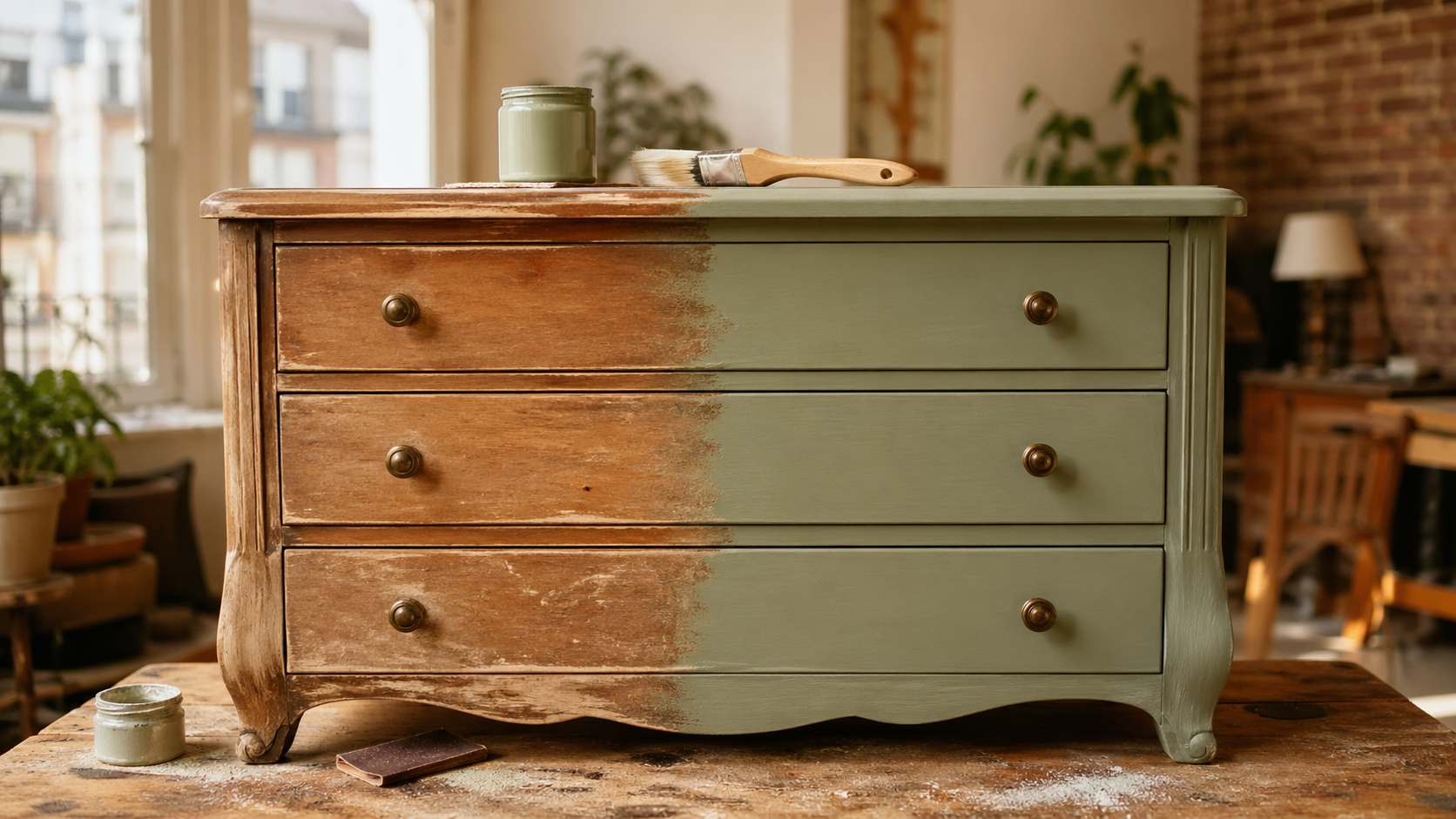
You're standing in front of a solid wood dresser at the thrift store. The brass hardware is tarnished, the finish is scuffed, and whoever owned it last clearly wasn't gentle. But the bones? Incredible. Dovetail joints. Real wood drawer boxes. A silhouette that hasn't been made since the 1970s. The question isn't whether it's worth saving — it absolutely is. The question is: where do you start?
DIY antique furniture restoration through painting is one of the most satisfying projects a home decorator can take on. A $25–$40 thrift store find can become the centrepiece of a room, with a finish that looks intentional, unique, and frankly expensive. And beyond the aesthetic payoff, there's something deeply satisfying about pulling a piece back from the brink — keeping it out of landfill and giving it decades more life.
This guide walks you through everything: how to assess a piece before committing, what supplies you actually need, which paint works best for which look, and four distinct techniques to achieve a vintage finish that feels authentically aged — not just sloppily painted. Whether you're a first-timer or you've got a few furniture makeovers under your belt, you'll find something useful here.
Is Your Piece Worth Restoring? How to Assess Before You Paint
Not every thrift store find deserves a makeover — at least not with paint. A few minutes of assessment before you commit will save you time, money, and frustration.
Solid wood is your best friend. Tap the surface — does it sound hollow? Check the underside and back panels for end grain. Real wood has visible grain running through it; MDF and particle board have a smooth, uniform cross-section. Solid wood pieces take paint beautifully and hold up for decades. Laminated or veneer-over-particle-board pieces can be painted, but they're trickier — aggressive sanding will blow through the veneer and expose the substrate.
Check the structure. Wobble the piece. Wiggle the drawers. Inspect the joints — look for gaps, cracking glue, or missing hardware. Structural issues aren't dealbreakers, but they need to be addressed before painting, not after. Wood glue and a few clamps can fix most loose joints; wood filler handles gouges and missing chunks.
Think about the silhouette. Pieces with interesting shapes — carved details, turned legs, tapered feet, unusual proportions — reward painting the most. The paint draws your eye to the form. Plain rectangular boxes are fine, but they won't wow anyone the way a shapely mid-century credenza will.
When to leave it alone. If a piece has a maker's mark, appears to predate 1900, or has an original finish in genuinely good condition, reconsider painting it — or at least do some research first. Painting a signed piece of significant value is irreversible and can dramatically reduce its worth. When in doubt, consult an antique dealer before reaching for the brush.
Gather Your Supplies: What You'll Need for DIY Furniture Painting
The good news: you don't need much, and nothing on this list will break the bank.
For cleaning and prep: dish soap, warm water, lint-free rags or microfibre cloths, and TSP substitute (trisodium phosphate substitute) for heavily soiled pieces. A bucket and rubber gloves round things out.
For sanding: 80–120 grit paper for initial surface prep and removing old paint buildup, and 220 grit for smoothing between paint coats. An orbital sander is a luxury — you can absolutely hand-sand a small piece, but it's worth renting one for larger items.
For painting: brushes (a good 2–3 inch angled brush for detail work and a wider brush or foam roller for flat surfaces), painter's tape, and a drop cloth or old bedsheet to protect your floors. Have a few small containers on hand for mixing glaze.
For finishing: your chosen topcoat (more on that below), a clean cloth for waxing, and fresh hardware if you're swapping it out.
In Montreal, you'll find most of what you need at hardware stores along Sherbrooke or Notre-Dame, or larger home improvement stores in Lachine and the surrounding area. Specialty chalk paint brands are available at craft and décor retailers throughout the city.
Choosing the Right Paint for Antique Furniture Restoration
This is where most beginners freeze. Walk into any hardware store and the paint aisle becomes overwhelming fast. Here's what you actually need to know.
Chalk Paint
Chalk paint is the undisputed favourite for DIY furniture restoration, and for good reason: it's incredibly forgiving. It adheres to almost any surface with minimal prep (often no primer needed), dries quickly, and produces a beautiful matte finish with a slightly velvety texture that looks inherently vintage. It's also wonderfully thick and covers in fewer coats than regular paint.
Brands like Annie Sloan and Rust-Oleum Chalked are widely available in Quebec. Expect to pay more per litre than regular paint, but the reduced prep time and coverage make it worth it. Chalk paint is ideal for distressed and antiqued finishes, and pairs naturally with wax as a topcoat.
Latex / Acrylic Paint
Standard latex or acrylic paint is more durable than chalk paint and comes in a virtually unlimited colour range. It's also more affordable. The trade-off: it requires thorough surface prep (clean, sand, prime) or it won't bond properly and will chip within months.
Latex is the better choice for pieces that will see heavy daily use — a kitchen island, a coffee table, a child's dresser. It's less forgiving of shortcuts, but the finish is harder and longer-lasting.
Milk Paint
Milk paint is made from natural pigments and casein (milk protein), and it's been used on furniture since the colonial era. That history shows in the results: milk paint produces the most authentically aged finish of any option. It chips and wears naturally over time, in a way that looks genuinely old rather than artificially distressed.
This unpredictability is either a feature or a bug depending on your goals. If you want a perfectly controlled, even finish, stick to chalk or latex. If you want a piece that looks like it's been loved for a hundred years, milk paint is your ally. It's also the most environmentally friendly option — worth noting for anyone who appreciates the full circular story of a restored thrift find.
Spray Paint
Spray paint is best reserved for hardware (knobs, handles, hinges) and small accent pieces. It's tricky to get an even coat on large surfaces without drips and overlap marks. Save it for the hardware refresh at the end.
Quick guide: Choose chalk paint for ease and vintage charm; latex for durability on hard-use pieces; milk paint for the most authentic aged look and eco-conscious finishing.
Step-by-Step: How to Prepare Furniture for Painting
Here's the truth about furniture painting: the prep is 80% of the result. Skipping or rushing any of these steps is the number one reason painted furniture chips, peels, or looks amateurish six months later. Twenty minutes of good prep is worth hours of corrective work later.
Step 1: Clean the piece thoroughly. Remove all grease, grime, and old wax. Mix a few drops of dish soap into warm water and wipe down every surface — top, sides, back, drawers, inside drawer openings. For pieces with significant grease or old wax buildup (common on kitchen furniture and pieces that have been polished repeatedly), use TSP substitute according to package directions. Let the piece dry completely before moving on.
Step 2: Remove all hardware. Unscrew every knob, handle, and hinge. Drop them into a labelled bag so nothing gets lost. This step is easy to skip and you'll regret it — paint around hardware always looks sloppy.
Step 3: Make structural repairs. Now is the time. Apply wood glue to loose joints, clamp if needed, and let cure fully (usually overnight). Fill gouges, cracks, and holes with wood filler, smooth with a putty knife, and allow to dry completely before sanding smooth.
Step 4: Sand the surface. You're not stripping the piece down to bare wood (unless it's deeply damaged) — you're just scuffing the surface enough that paint has something to grip. For chalk paint, a light pass with 120 grit is usually sufficient. For latex, be more thorough: sand with 80–100 grit to remove loose finish and create a proper tooth. Always sand in the direction of the grain.
Step 5: Wipe away dust. Use a tack cloth or a damp lint-free rag to remove every trace of sanding dust. Dust trapped under paint creates a gritty, uneven finish. Let the piece dry again if you used a damp cloth.
Step 6: Prime if needed. Chalk paint usually doesn't need primer. For latex paint, for pieces with very dark stains, or for wood that's been treated with oil, a shellac-based or water-based primer is essential. Apply one even coat, let dry, and lightly sand with 220 grit before painting.
Painting Techniques for a Vintage, Antique Finish
This is where the transformation happens. Each of the four techniques below produces a distinctly different result — choose the one that fits the piece and the space it's going into.
Technique 1: Classic Solid Paint
Best for: A clean, polished look that bridges vintage form and modern simplicity. Think freshly painted mid-century sideboard in sage green or warm white.
How to do it: Apply your first coat using a quality brush (work in the direction of the grain) or a foam roller for large flat surfaces. Keep coats thin — it's far better to apply two or three thin coats than one thick one. Let each coat dry fully according to the paint manufacturer's instructions. Lightly sand with 220 grit between coats to smooth any brush marks, then wipe away dust before the next coat. Two to three coats typically achieves full, even coverage.
The result: A smooth, intentional finish that lets the furniture's form do the talking. Add new hardware at the end and it reads as a deliberate, contemporary piece.
Technique 2: Distressing
Best for: Shabby chic, cottage, and rustic aesthetics. Works beautifully on ornate or carved pieces.
How to do it: Apply your base coat and let it dry completely. Then, using 220 grit sandpaper, sand back the paint in the areas where natural wear would actually occur: raised edges, corners, around hardware holes, chair legs near the floor. The goal is to reveal glimpses of wood (or a previous paint colour) beneath. Work gradually — you can always remove more paint, but you can't put it back. A light pass gives a gently worn look; more aggressive sanding reads as heavily aged.
Key insight: Resist the urge to distress flat, central surfaces. Natural wear happens at edges and contact points, not in the middle of a drawer front.
The result: A piece that looks like it's been in the family for generations — worn in all the right places.
Technique 3: Antiquing with Glaze
Best for: Adding depth, shadow, and an aged patina to detailed or carved pieces. Glaze settles into crevices and creates the look of decades of accumulated character.
How to do it: Apply your base coat and let dry completely. Mix a glaze solution: roughly one part satin-finish paint in a contrasting colour (often a dark brown, raw umber, or black) with two parts glazing medium, then add water a little at a time until the mixture is slightly runny but still holds to a brush. Working in small sections, brush the glaze mixture over the surface and allow it to sit for a minute or two. Then, using a damp lint-free cloth, wipe back the glaze with long, even strokes. The glaze will wipe cleanly from flat surfaces but settle into carved details, crevices, and mouldings — creating the illusion of age.
For a more permanent result: Antiquing toner (available from specialty paint suppliers) works similarly to glaze but doesn't wipe off once dry, giving you a more durable aged finish that won't require extra sealing.
The result: A piece that looks hand-crafted and genuinely old, with depth and shadow that you simply can't achieve with a flat coat of paint alone.
Technique 4: Whitewashing / Colour Washing
Best for: Natural wood pieces where you want to soften the colour while keeping the grain visible. Beautiful on pieces with interesting wood texture — oak, ash, reclaimed wood.
How to do it: Dilute your paint with water at roughly a 1:1 ratio (a slightly looser mix lets more grain show through; a thicker mix gives more colour coverage). Brush the diluted paint onto the surface, working it into the grain. While still wet, use a dry or slightly damp cloth to wipe back partially, letting the grain show through a translucent veil of colour. Work in manageable sections so the paint doesn't dry before you can manipulate it.
The result: A soft, layered look that feels Scandinavian or coastal depending on your colour choices. White or pale cream gives a driftwood effect; muted sage or dusty blue creates something more moody and European.
Sealing and Protecting Your Finished Piece
Paint without a topcoat is paint waiting to get damaged. Sealing your work protects it from chips, scratches, and moisture — and it's the step that separates a finish that holds up for a decade from one that starts peeling in six months.
Wax is the traditional companion to chalk paint. Applied with a soft cloth in circular motions and buffed to a subtle sheen, wax gives a matte, slightly lustrous finish that feels authentically old. It's beautiful, but it's not the most durable option — avoid it on surfaces that will see constant moisture or heavy use. Reapply every year or two to maintain protection.
Water-based polyurethane is the toughest topcoat option and the right choice for high-use surfaces: tabletops, kitchen furniture, children's pieces. Opt for a water-based formula over oil-based — it dries faster, doesn't yellow over time, and is much easier to clean up. Apply two coats, sanding lightly with 220 grit between them.
Water-based topcoats (sometimes marketed as "furniture topcoat" or "clear coat") split the difference: more durable than wax, less plastic-looking than polyurethane. A good choice for decorative pieces that will see moderate use.
Apply your chosen sealer in thin, even coats. Two coats is the standard; three if the piece will see hard use.
Hardware, Final Touches & Styling
The hardware is the jewellery of the piece — don't overlook it.
If the existing hardware is in good shape, a coat of spray paint transforms it entirely. Matte black and satin brass are both perennially strong choices; antique bronze reads as more period-appropriate on carved or ornate pieces. Clean the hardware thoroughly first, apply a coat of spray primer, then two light coats of spray paint, finishing with a clear sealer for durability.
Replacing hardware entirely is the other option — and thrift stores are often the best place to find vintage hardware that's more authentic than anything you'd buy new. A matching set of mid-century pulls or ceramic knobs can define the entire aesthetic of a piece. Keep an eye out when you're shopping.
One styling note: a single painted statement piece can anchor an entire room without everything else needing to match. The painted dresser, the lacquered side table, the distressed bookcase — each one can stand alone against more neutral surroundings. In a Plateau walk-up or a Mile End loft, a carefully restored vintage piece in an unexpected colour feels exactly right: considered, personal, and a little bit adventurous.
Bring Your Vision to Life — Starting with the Right Find
Here's the honest truth about antique furniture restoration: the hardest part isn't the painting. It's finding a piece worth transforming in the first place. A mediocre find produces a mediocre result no matter how skilled the technique. A piece with great bones, beautiful proportions, and genuine character? That's where the magic happens.
At EcoDepot Montreal, new furniture arrives every week across both our Lachine and Plateau locations — solid wood dressers, mid-century credenzas, vintage chairs with turned legs, side tables that have been waiting decades for someone to see their potential. These are exactly the kinds of pieces that reward a skilled paint job.
Stop by and take your time browsing. Turn drawers over, check the joints, look for grain. When you find the right piece, you'll know — and then you'll have everything you need to bring it back to life.
📍 Lachine: 187 Rue Richer, Lachine 📍 Plateau: 2117 Rue Rachel Est | 1307 Mont-Royal Ave E 🕙 Open Monday–Sunday | Follow @ecodepotmontreal for first looks at new arrivals