Cart
0
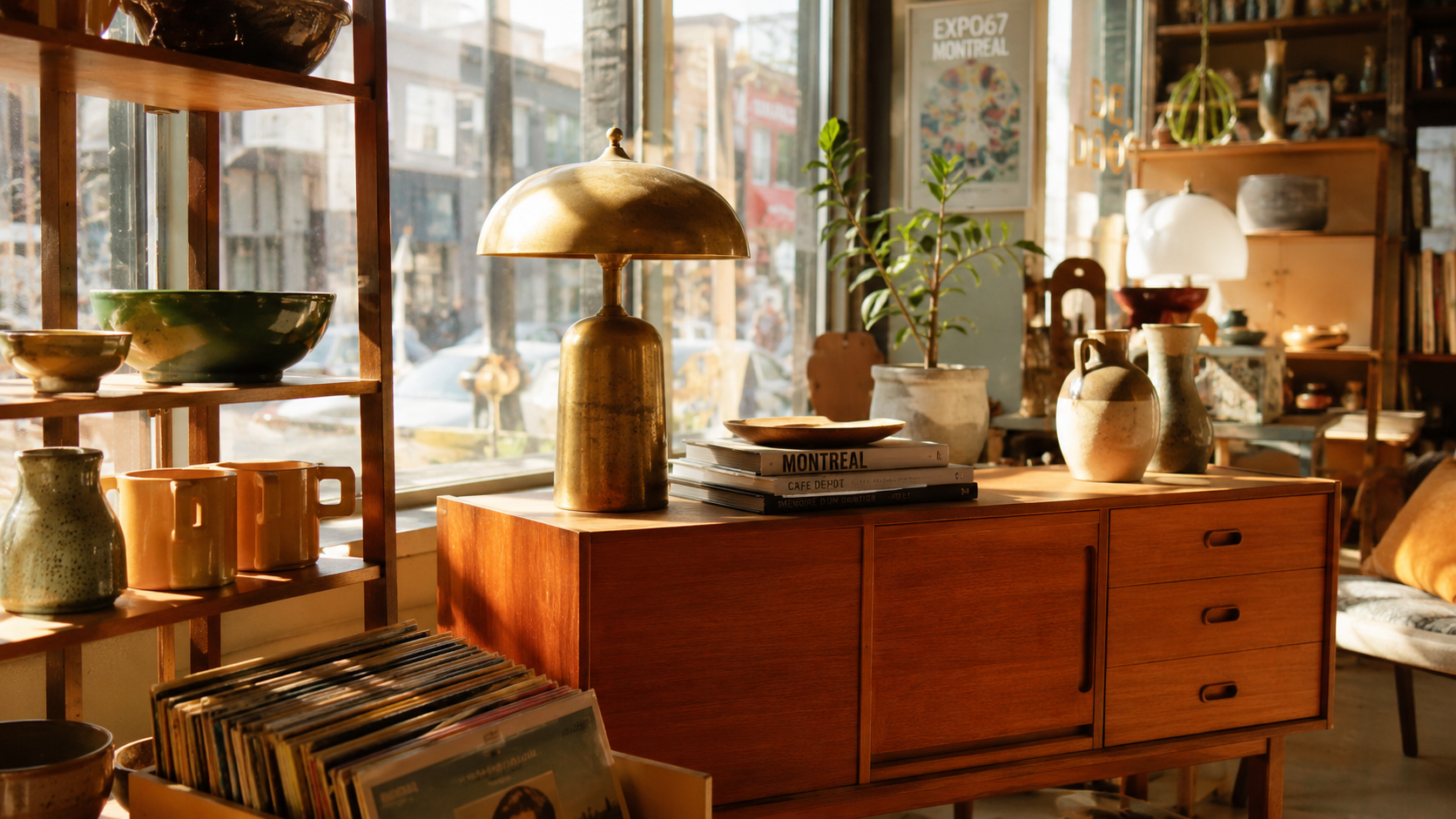
You're standing in a thrift store. There are lamps on shelves, chairs stacked in corners, ceramics lined up in rows, racks of unknowable things. It's a lot. Where do you even begin?
Here's the good news: there's no wrong place to start. Starting a vintage collection doesn't require expertise, a design degree, or a big budget. It requires curiosity — and a little guidance to point you in the right direction.
Montreal is one of the best cities in Canada for second-hand hunting. Between its student culture, dense neighbourhoods, and a long tradition of valuing what came before, the city has a uniquely rich thrift ecosystem. Pieces that would cost thousands at a design boutique turn up regularly on thrift store shelves — mid-century chairs, Italian ceramics, vintage lighting, Scandinavian teak. You just have to know how to look.
This guide walks you through exactly that: how to start a vintage collection from scratch, build your eye over time, and find pieces you'll genuinely love — without overspending, without overwhelm, and without needing to become an expert overnight.
Step 1: Start With a Feeling, Not a Category
The most common beginner mistake isn't paying too much for something or missing a great find. It's trying to collect everything at once — or worse, copying an aesthetic wholesale from Pinterest without knowing why it resonates.
Before you set foot in a store, spend ten minutes walking through your home. What do you actually love in the spaces you've already created? What colours, textures, and shapes keep appearing? Is there a warmth to the things you're drawn to — warm wood tones, earthy ceramics, woven textiles? Or do you gravitate toward sleek lines, chrome, and graphic shapes?
You don't need to know that you love "Danish modernism" or "post-war Italian design." You just need to notice what makes you stop in your tracks.
A few of the most common vintage styles you'll encounter in Montreal thrift stores:
Mid-century modern (roughly 1950s–1970s): Clean lines, tapered legs, organic shapes. Think teak credenzas, Eames-era chairs, architectural lamps. Hugely popular and well-represented in Montreal stores.
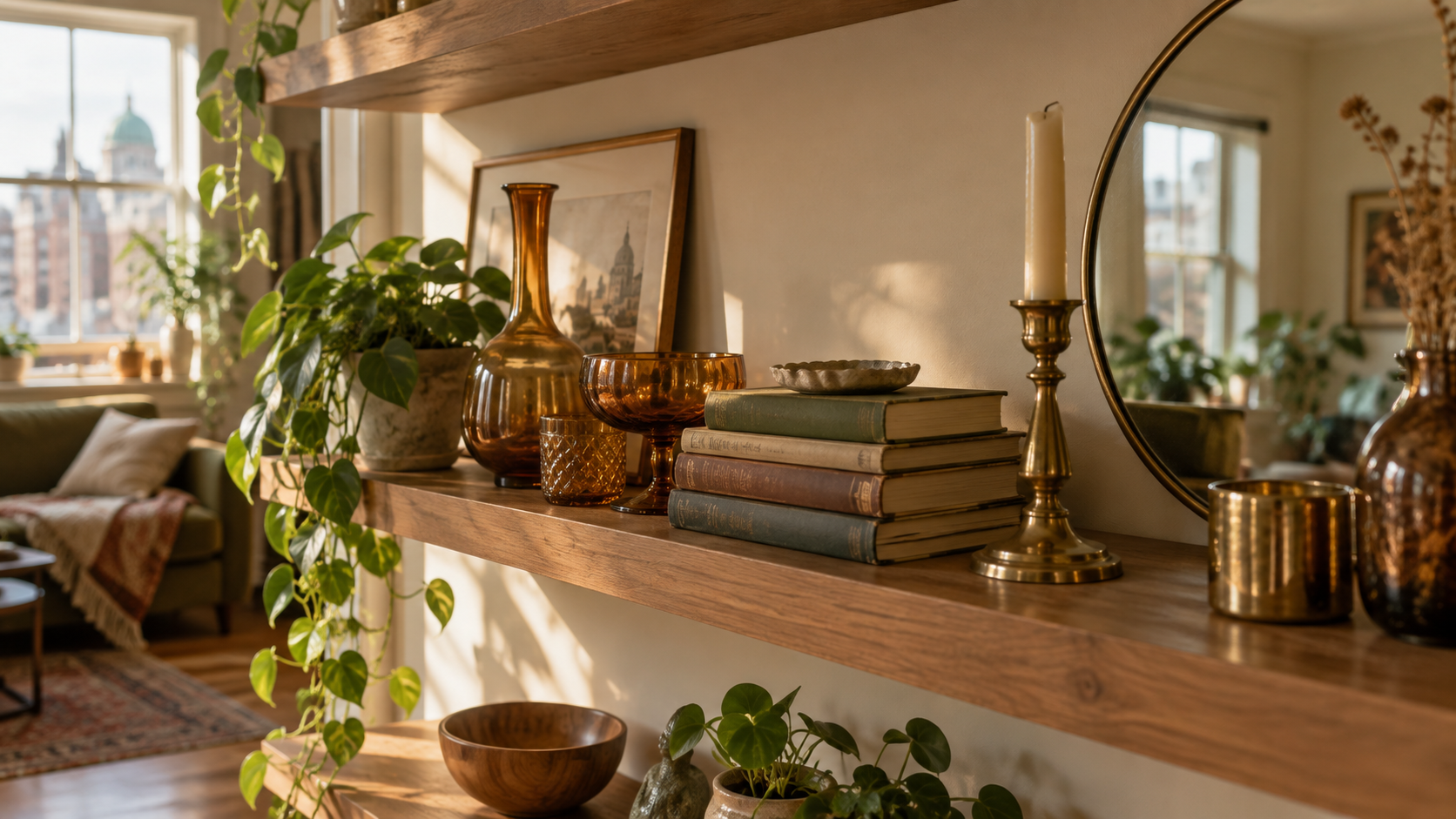
70s boho: Warm, earthy tones, rattan, macramé, ceramic vases in amber and rust. Very findable — and very much having a moment.
Art deco (1920s–1940s): Geometric patterns, rich materials, glamour. Harder to find in perfect condition, but the occasional mirror or brass piece is worth the hunt.
Industrial / mid-century utilitarian: Factory lighting, metal shelving, enamelware. Functional and endlessly versatile.
Pick one or two that feel like you — not like someone you wish you were — and let that be your compass.
Step 2: Pick One Category to Focus On First
Collecting vintage is more rewarding when you go deep in one direction before spreading wide. Trying to curate furniture, ceramics, lighting, art, and textiles all at once leads to a cluttered, unfocused home and a lot of impulse buys you'll regret.
Instead, pick one category to start with. Here are the most beginner-friendly:
Lighting is one of the highest-impact, lowest-risk places to start. A great vintage lamp transforms a room in a way that few other objects can. It's also one of the most findable categories — thrift stores in Montreal consistently have vintage lamps, from simple ceramic bases to proper designer-era pieces. And unlike furniture, a lamp is easy to test, easy to carry, and easy to sell if you change your mind.
Ceramics and pottery offer accessible price points, enormous variety, and an easy learning curve. Vintage ceramic vases, bowls, mugs, and decorative objects are everywhere in thrift stores. You'll start to develop instincts quickly — recognizing glazes, makers' marks, and the tactile difference between a thoughtfully crafted piece and a mass-produced one.
Framed art and mirrors are low-risk and high-reward. A great vintage mirror can anchor an entire room. A collection of mismatched frames (unified by subject matter or colour palette) adds character that no furniture purchase can replicate.
Furniture accents — side tables, armchairs, small sideboards — are where the real drama is, but they require more patience and discernment. Start here only if you have a specific gap to fill and a clear sense of what you're looking for.
Vinyl records and vintage audio deserve a mention for the music lovers in the room. EcoDepot consistently stocks records across genres, alongside turntables, speakers, and vintage audio gear. It's a rabbit hole worth jumping into.
Starting focused doesn't mean staying focused forever. It means building your eye and your confidence in one area before expanding.
Step 3: Learn to Read an Object
You don't need to be an expert to recognize quality. You need to slow down and pay attention — which is a skill that develops quickly once you start practising it.
Here's a quick-read framework for any object you pick up:
Turn it over. The bottom of a piece tells you more than the front. Look for maker's marks, stamps, country of origin, or mould numbers. A ceramic marked "Italy," "Japan," or with a studio potter's signature is worth a closer look. Furniture often has manufacturer's labels on the underside of drawers or along the back.
Check the materials. Run your hand along it. Solid wood feels different from veneer — there's weight and warmth to it. Brass has a particular heft; plated metal feels lighter and may show flaking at edges. Ceramic rings differently than plastic when tapped. Your hands will learn to read these things faster than your eyes.
Distinguish patina from damage. Patina is the natural aging of materials — a brass lamp that's deepened in colour over decades, a wooden surface with a lived-in sheen. That's not a flaw; it's what makes vintage objects beautiful. Damage is different: deep scratches that compromise structure, chips that affect function, cracks in ceramics, water damage in wood. Learn to tell the difference, and you'll stop passing on pieces that just need a gentle clean.
Do the wobble test on furniture. Sit in the chair. Open the drawer. Pull on the leg. Vintage furniture was often built to last, but decades of use take a toll. What you're checking for is structural soundness — wobbly joints, drawer runners that stick, frames that flex when they shouldn't.
Trust your instincts. If something stops you, pick it up. The pieces that catch your attention for no obvious reason are often the ones worth examining more closely.
Step 4: Time Your Visits — The Montreal Advantage
Here's something most beginners don't know: when you shop matters as much as how you shop.
Thrift stores receive new inventory continuously, and the best pieces move fast. If you're visiting on a Sunday afternoon after a weekend of traffic, you're seeing what's left — not what arrived. Early weekday visits, especially mid-morning on weekdays, are often when the freshest inventory is on the floor.
EcoDepot Montreal receives new arrivals every week across both locations. That means the store you visited two weeks ago looks meaningfully different today. Regular visitors — the ones who seem to always find the good stuff — aren't luckier than you. They just show up more often and earlier.
A few Montreal-specific timing notes worth knowing:
The city's strong student and young professional population means a constant churn of high-quality donations, especially around September (back-to-school moves) and April–May (end-of-lease season). These are prime months to find furniture, electronics, and home goods that people couldn't take with them.
Follow @ecodepotmontreal on Instagram for first looks at new arrivals. It's genuinely one of the better ways to know what's landed before you make the trip — the store regularly posts pieces that would otherwise disappear before most shoppers arrive.
Step 5: Build Your Eye Over Time — Not Your Shelves All at Once
Patience is the most underrated skill in vintage collecting. The collectors whose homes look effortlessly curated didn't furnish them in an afternoon — they built them over years, one right piece at a time.
There's a philosophy in vintage circles sometimes described as "slow decorating." It's the opposite of the big-box approach, where you arrive home with six bags and a matching set of everything. Slow decorating means buying one ceramic vase because it's exactly right, placing it on a shelf, and living with it for a while before adding the next thing.
Not buying something is also a skill. Every time you put something back because it wasn't quite right — even though the price was tempting — you're training your eye. You're getting clearer about what you actually want.
A practical tool: keep a notes app or photo album on your phone of pieces you loved but didn't buy. Over time, patterns emerge. You'll notice you keep photographing warm-toned ceramics, or that every lamp you stop at has a similar silhouette. These patterns tell you your taste more clearly than any style quiz can.
The one-anchor-piece approach is a great way to start styling as you go: one meaningful vintage object on a shelf, a lamp on a side table, a framed print leaning against a wall. It doesn't take much to shift a room's feeling. And from there, you'll know exactly what to look for next.
Step 6: Know What to Skip (For Now)
Part of building a strong collection is knowing what to leave behind — at least until you have more experience.
A few categories that are trickier for beginners:
Upholstered furniture hides its problems. A sofa or armchair can look great at first glance and reveal structural issues, odours, or fabric damage only after it's in your home. If you're not willing or able to reupholster, pass on upholstered pieces until you know what to look for.
Electronics without testing. Vintage audio gear, record players, cameras — all worth collecting, but only if you can verify they work before buying. EcoDepot tests what it can, but not every piece in every thrift store comes with that guarantee. Ask before you assume.
Art without any context. Buying a painting or print is a deeply personal choice, and there's nothing wrong with buying something simply because you love it. But if you're drawn to pieces with potential value (signed prints, oil paintings, photography), take time to learn the basics of authentication before spending significantly.
Items requiring major restoration — unless you're a DIYer who genuinely enjoys the process. A chair with beautiful bones but a broken frame, a lamp that needs rewiring, a dresser that needs stripping and refinishing — these are worthwhile projects, but only if you have the tools, time, and inclination. If you don't, they become expensive mistakes.
None of these categories are off-limits forever. They're just areas where experience pays off more than instinct.
Where to Start Your Hunt in Montreal
Montreal's thrift scene is genuinely exceptional. The combination of dense, design-conscious neighbourhoods, a large student population, and a strong culture of circular consumption means quality pieces rotate through stores constantly.
For beginners, the most practical starting point is a store with breadth and curation — somewhere you can explore multiple categories in one visit, with staff who know the inventory and can help orient you.
EcoDepot Montreal is exactly that kind of store. With two distinct locations across the city, weekly new arrivals, and an inventory that spans mid-century furniture, vintage lighting, ceramics, vinyl, electronics, clothing, and more, it's built to be both a treasure hunt and a genuine resource for anyone starting (or deepening) a vintage collection.
Lachine — 187 Rue Richer, Lachine, QC H8R 1R4 The Lachine store is the place to go for larger finds — furniture, statement pieces, storage. If you're furnishing a space or hunting for that one standout chair or credenza, start here. The scale of inventory means more to explore and more chances of finding something genuinely unexpected.
Plateau — 2117 Rue Rachel Est & 1307 Mont-Royal Ave E, Montreal The Plateau locations are ideal for decor, ceramics, lamps, art, vinyl, and smaller collectibles. The neighbourhood energy suits the discovery-oriented browsing that vintage collecting rewards — you're not rushing; you're exploring. Perfect for those Plateau walk-ups and Mile End lofts that call for exactly this kind of character.
Both locations are open Monday to Wednesday 10am–6pm, Thursday and Friday 10am–8pm, and weekends 10am–6pm.
Pre-owned shopping is increasingly mainstream across Canada — and for good reason. The quality, sustainability, and affordability of second-hand finds have made thrift shopping a first choice, not a compromise, for more and more Montreal shoppers. EcoDepot is at the centre of that shift, and visiting regularly is one of the best habits a new collector can build.
The Best Collections Start With One Good Find
Starting a vintage collection isn't a project you complete. It's something you grow into — gradually, pleasurably, with each visit teaching you something new about what you love and what you're looking for.
The pieces that will matter most to you five years from now probably aren't the ones you plan for. They're the ones that stopped you on an ordinary Tuesday, that you almost put back and then didn't. That's the thrill at the heart of vintage collecting — and it's completely accessible from your very first visit.
Every item deserves a second act. Your style doesn't have to cost the earth. And the best pieces, without exception, have history.
Come explore EcoDepot's Lachine or Plateau locations — new arrivals land every week, and your next favourite piece might already be waiting. Follow us on Instagram at @ecodepotmontreal so you never miss a fresh find, and visit us at ecodepotmontreal.com to learn more.