Chariot
0
For vintage shoppers and design enthusiasts, understanding Scandinavian design opens up a world of possibility. You'll learn to spot authentic mid-century treasures, understand what makes certain pieces timeless rather than trendy, and discover why choosing vintage Scandinavian furniture is one of the most sustainable design decisions you can make. Whether you're furnishing a Mile End loft or hunting for that perfect statement piece, this guide will walk you through everything from the movement's cultural roots to practical tips for finding authentic pieces in Montreal.
Defining Scandinavian Design: More Than Just Minimalism
Scandinavian design is a design movement characterized by simplicity, functionality, and a deep connection to nature that emerged from the Nordic countries in the early 20th century and flourished through the mid-century period.
But that simple definition barely scratches the surface. Scandinavian design encompasses the design traditions of Denmark, Sweden, Norway, Finland, and Iceland—countries that developed a shared aesthetic language despite their individual differences. This movement revolutionized everything from furniture and lighting to textiles and glassware, always maintaining a core philosophy: design should serve people's real needs while bringing beauty into everyday life.
What Scandinavian design IS: warm minimalism that prioritizes human comfort, natural materials that age beautifully, clean lines that never feel cold, spaces filled with light and air, democratic accessibility that puts good design within everyone's reach, and a sustainable approach that values quality over quantity.
What it ISN'T: sterile minimalism without personality, expensive exclusivity, trend-chasing aesthetics, or ornamentation for its own sake.
The core characteristics that define this movement include clean, organic lines that balance geometry with softness; natural materials like teak, oak, wool, and leather; light, neutral color palettes designed to maximize brightness; functional furniture where every element serves a purpose; and democratic ideals that reject elitism in favor of accessible beauty. These aren't just design choices—they're reflections of Nordic culture and values that continue to resonate globally today.
The Cultural Roots: Why Scandinavia Created This Design Philosophy
Scandinavian design didn't emerge from aesthetic theory or artistic movements alone. It was born from necessity, shaped by geography and culture in ways that made it fundamentally different from design traditions elsewhere in Europe.
Consider the Scandinavian climate: long, dark winters where daylight might last only a few hours; harsh weather that kept people indoors for extended periods; compact living spaces that needed to serve multiple functions. In this environment, design wasn't about decoration—it was about survival and quality of life. Maximizing natural light became essential, not optional. Furniture had to be functional and comfortable because Scandinavians spent more time with their furniture than people in more temperate climates. Every square meter mattered in smaller homes, making multi-functional design crucial.
But climate alone doesn't explain Scandinavian design. The movement was equally shaped by social values that emerged in the Nordic countries, particularly after World War II. Many Scandinavian nations embraced social democracy, emphasizing equality, accessibility, and quality of life for all citizens. These political ideals translated directly into design philosophy through what became known as "democratic design"—the revolutionary idea that beautiful, well-made objects shouldn't be reserved for the wealthy elite.
This egalitarian approach meant designers focused on creating pieces that were affordable to produce, durable enough to last generations, beautiful without being ostentatious, and functional for real families and real homes. It's why you'll find mid-century Scandinavian furniture that's still perfectly usable today, decades later—these pieces were designed with permanence in mind, not planned obsolescence.
Two cultural concepts capture the essence of this philosophy. Hygge, the Danish word for coziness and contentment, influenced how spaces should feel—warm, inviting, restorative. It's not just about aesthetics; it's about creating environments that nurture wellbeing during long, dark months. Lagom, the Swedish concept meaning "just right" or "not too much, not too little," shaped the movement's approach to balance. No excess, no shortage—just the perfect amount of everything. Together, these concepts created a design movement that valued human comfort and psychological wellbeing as much as visual appeal.
The Historical Evolution: From Folk Craft to Global Movement
Early Influences (Late 1800s-1920s)
For centuries, Scandinavian countries existed on the periphery of European cultural movements. Lacking major cultural capitals like Paris, London, or Vienna, the Nordic region developed somewhat in isolation, with craft traditions passed through master-apprentice relationships. Industrialization came later to Scandinavia than to other European nations, meaning traditional craftsmanship remained deeply valued even as new technologies emerged.
The turning point came with the Great Nordic Exhibition of 1888, which finally introduced Scandinavian design to the rest of Europe. For the first time, the world saw how Nordic artisans combined centuries-old craft skills with emerging industrial knowledge. The exhibition also exposed Scandinavian designers to international movements like Art Nouveau and Arts and Crafts, creating a creative exchange that would shape the decades to come.
By the last quarter of the 19th century, technological advancements meant information moved more quickly across borders. Scandinavian countries suddenly had both the industrial capabilities and the artisan skills needed to produce objects that appealed to international markets. Yet they maintained something unique: a connection to craft traditions and natural materials that mass-production elsewhere was abandoning.
The Breakthrough Years (1925-1940s)
The 1925 Paris Exposition des Arts Décoratifs et Industriels Modernes marked Scandinavian design's explosive arrival on the world stage. Swedish design dominated the exhibition, taking home 35 Grand Prix awards, 46 gold medals, 13 bronze medals, and 13 honorable mentions—more than any other country. The world had officially taken notice.
By the 1939 New York World's Fair, Scandinavian style was cemented in the global imagination, with Swedish and Danish Modern styles prominently displayed. Companies like Georg Jensen, Royal Copenhagen, Bing and Grøndahl, Kosta, and Orrefors became international names by hiring the best Scandinavian designers and craftsmen. These firms proved that industrial production and beautiful design could coexist, that mass-market didn't have to mean mass-mediocrity.
World War II, paradoxically, accelerated the movement's development. Material shortages and limited access to international markets forced Scandinavian companies to reinvent themselves with what they had. This constraint bred innovation. The result was homewares that were useful, minimalistic, and brilliantly designed—exactly what the post-war world needed. The German Bauhaus School's influence on functionality merged with Scandinavian warmth, creating something entirely new: design that was rational without being cold, minimal without being stark, functional without sacrificing beauty.
The Golden Age (1950s-1970s)
The 1954 "Design in Scandinavia" exhibition at the Brooklyn Museum launched what would become a decades-long American love affair with Scandinavian Modern furniture. Suddenly, Danish teak credenzas and Swedish chairs were gracing homes across North America. The clean lines and natural materials offered a refreshing alternative to the heavy, ornate furniture that had dominated for generations.
The Lunning Prize, awarded annually from 1951 to 1970 to outstanding Scandinavian designers, played a crucial role in defining and promoting the movement. Two designers received the prize each year, creating an official pantheon of Scandinavian design excellence that helped establish which works were considered canonical.
Throughout the 1950s and 1960s, Scandinavian designers repeatedly triumphed at the Milan Triennale, an international exhibition held every three years. These successes cemented Scandinavia's reputation as a global leader in modern design, proving that the movement wasn't a passing trend but a fundamental shift in how people thought about their living spaces.
The Pioneers: Iconic Designers Who Shaped the Movement
The Golden Age of Scandinavian design produced designers whose work remains influential—and highly collectible—today. Understanding these figures helps you recognize authentic pieces and appreciate what makes certain designs timeless.
Denmark emerged as perhaps the most influential force in Scandinavian furniture design. Arne Jacobsen created the Egg Chair in 1958 and the Swan Chair the same year—both organic forms that seem to wrap around the sitter, combining sculptural beauty with exceptional comfort. Hans Wegner designed over 500 chairs during his career, but the Wishbone Chair from 1949 remains his most iconic work, a perfect marriage of organic form and lightweight construction. Børge Mogensen led the charge for democratic furniture at FDB (a Danish cooperative), creating pieces that ordinary families could afford without sacrificing quality or design. Poul Henningsen revolutionized lighting with his PH Lamps in 1926, using layered shades to create glare-free illumination—a design so successful it's still in production nearly a century later.
Finland contributed its own distinctive voice through designers who worked across multiple media. Alvar Aalto pioneered the use of bent plywood in furniture, creating pieces with flowing, organic forms that seemed to grow rather than be constructed. His glass vases, inspired by Finnish lakes and islets, remain design icons. His wife, Aino Aalto, made equally important contributions through her glassware designs. Maija Isola brought bold pattern and color to the movement through her work with Marimekko, proving that Scandinavian design could be exuberant and playful while maintaining its core principles.
Sweden and Norway produced their own influential designers, like Bruno Mathsson, whose ergonomic chairs demonstrated how thorough understanding of human anatomy could inform design. The collective impact of these designers created a movement greater than any individual contribution.
What makes these pieces endure? They solved real problems elegantly, used materials honestly, improved with age rather than becoming dated, balanced innovation with timelessness, and prioritized human comfort without sacrificing visual appeal. A Wegner chair from 1949 doesn't look "retro" in a contemporary space—it simply looks beautiful and well-made, as relevant now as when it was created.
Core Design Principles: The DNA of Scandinavian Aesthetics
Understanding the principles that unite Scandinavian design helps you evaluate pieces and understand why certain furniture transcends trends.
Functionality First doesn't mean sacrificing beauty for utility. It means that form grows from function, that every design element serves a purpose. Scandinavian designers approached furniture the way engineers approach problems: identifying needs, considering ergonomics, eliminating unnecessary elements. The result is pieces where you can see the logic of their construction, where every curve and angle has a reason.
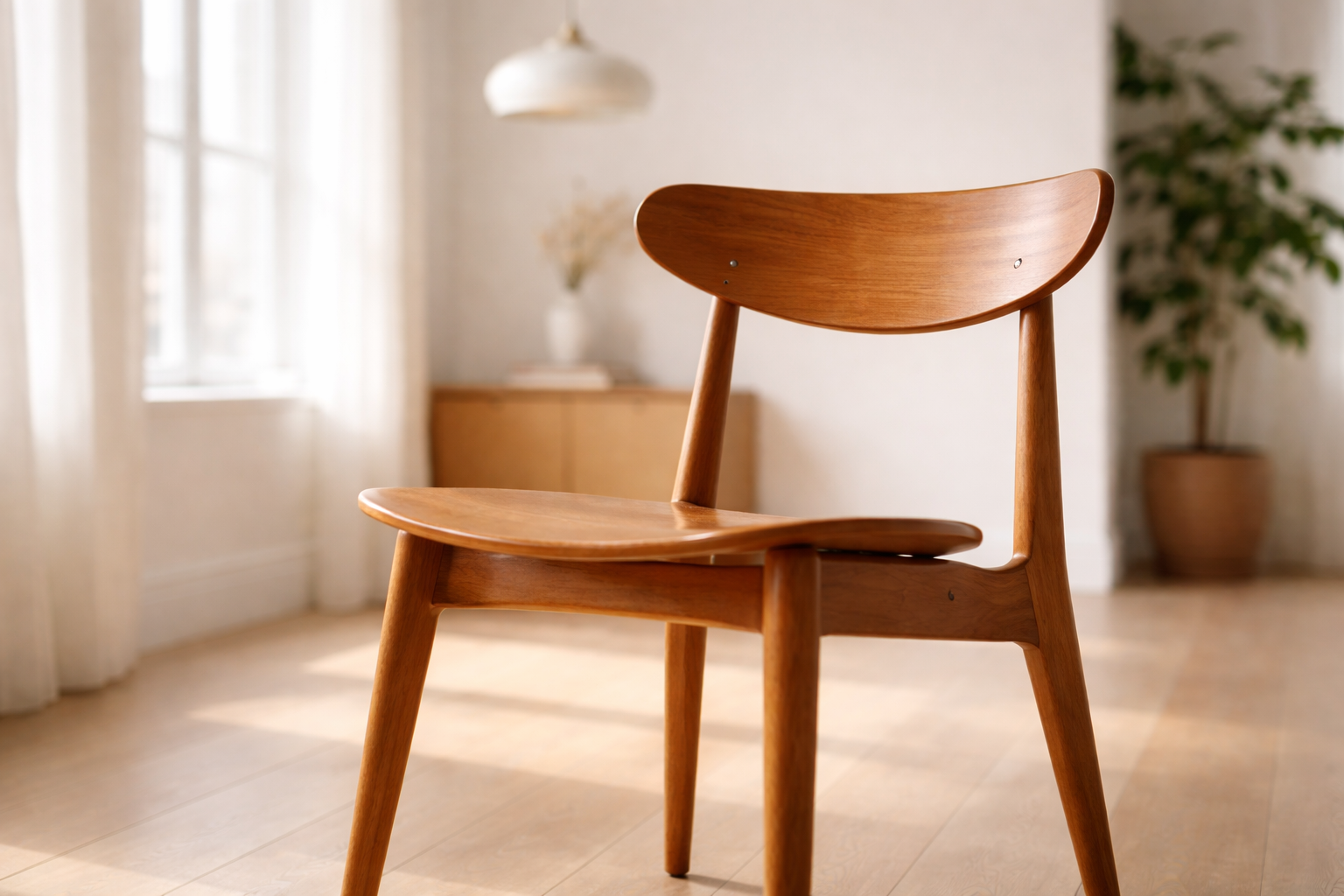
Simplicity and Clean Lines characterize the visual language of Scandinavian design, but it's simplicity achieved through refinement, not absence. These designers removed ornamentation through countless iterations, leaving only what enhanced both function and beauty. Clean lines often feature organic curves that soften geometric forms—tapered furniture legs, gently rounded chair backs, flowing lamp bases. The goal is visual clarity without coldness, order without rigidity.
Natural Materials form the foundation of Scandinavian design's tactile warmth. Teak, oak, birch, and pine were chosen not just for their beauty but for how they age, developing patinas that tell stories. Leather softens and gains character over decades. Wool and linen provide texture that synthetic materials can't match. Glass and ceramics showcase craftsmanship through their clarity and form. Importantly, these materials aren't hidden or disguised—wood grain shows, leather develops a patina, textiles display their weave. This honest expression of materials reflects a broader cultural value of authenticity.
Light and Space obsession grew directly from Nordic winters, where daylight might last only a few hours. Maximizing natural light became a design imperative. Pale color palettes—whites, grays, soft pastels—reflect light throughout spaces. Large windows and minimal window treatments allow maximum light penetration. Open, airy arrangements prevent spaces from feeling cramped or dark. Strategically placed mirrors multiply light and create depth. Every design choice asks: does this make the space feel brighter and more open?
Democratic Accessibility distinguished Scandinavian design from elitist design movements. The goal was creating beautiful, functional pieces that ordinary families could afford. This meant designing for mass production without compromising quality, using materials that were durable but not precious, creating pieces that served multiple functions, and focusing on longevity over luxury. This democratic ideal is why you'll find mid-century Scandinavian pieces at such a range of price points—some designers created luxury items, but many focused on everyday objects that brought good design into average homes.
Connection to Nature runs through every aspect of the movement. Organic forms echo natural shapes—curves suggesting trees or water, textures evoking stone or bark. Natural materials bring the outdoors inside. Even the color palette draws from Nordic landscapes—pale wood tones, sky grays, ocean blues, forest greens. This wasn't just aesthetic preference; it reflected a cultural relationship with nature shaped by geography and climate. Bringing natural elements into the home created psychological comfort during long winters when outdoor access was limited.
For anyone committed to sustainable living, these principles offer more than aesthetic guidance. They represent a design philosophy that valued quality over quantity, durability over disposability, and timeless appeal over trending styles—principles that feel more relevant than ever.
Global Expansion: How Scandinavian Design Conquered the World
By the 1960s, Scandinavian design had established itself internationally, but its true global dominance came through mass-market expansion that brought Nordic aesthetics to millions.
The IKEA Revolution beginning in the 1970s democratized Scandinavian design at an unprecedented scale. Founded by Ingvar Kamprad in Sweden in 1943, IKEA pioneered flat-pack furniture that customers assembled themselves, dramatically reducing costs while maintaining Scandinavian design principles. The company's mission—"to create a better everyday life for the many people"—embodied the democratic design ideals that had always been central to the Scandinavian movement. Through IKEA, clean lines, natural materials, and functional minimalism became accessible to people across economic backgrounds worldwide.
Marimekko and Finnish Textiles offered a different dimension to Scandinavian design's global reach. Founded in 1951, Marimekko became internationally famous for bold, colorful prints and innovative textile designs. Where some associated Scandinavian design with muted palettes, Marimekko proved the movement could embrace vibrant pattern and playfulness while maintaining its core values. The company's success—particularly its bold "Unikko" poppy pattern from 1964—showed that Scandinavian design was diverse enough to encompass both minimalism and exuberance.
Architecture and Beyond extended Scandinavian influence far beyond furniture. Nordic architects created buildings that embodied the same principles as the furniture: functional, beautiful, human-scaled, connected to nature. Scandinavian design principles even influenced consumer electronics—the clean, intuitive interfaces of Apple products owe debts to Scandinavian design thinking. Automotive design from Volvo and SAAB reflected safety-first functionality combined with understated elegance. Fashion brands like COS, Acne Studios, and Filippa K brought Scandinavian minimalism to clothing: neutral palettes, clean silhouettes, quality materials, versatile pieces.
21st Century Resurgence brought Scandinavian design back into the spotlight through multiple channels. The Instagram era's love of minimalism drew heavily from Scandinavian aesthetics—white walls, natural wood, abundant plants. The mid-2010s "hygge" trend popularized Danish concepts of coziness globally, making Scandinavian lifestyle ideas as influential as Scandinavian design. Most significantly, the global sustainability movement aligned perfectly with Scandinavian design values—quality over quantity, durability over disposability, natural materials over synthetics, timeless design over fast furniture.
Scandinavian Design Today: New Nordic Movement and Contemporary Influence
Contemporary Scandinavian designers face a unique challenge: how to build on an incredibly influential legacy while establishing their own identities. As Danish designer Cecilie Manz observed, the rich heritage of Scandinavian design can be a "double-edged sword"—an abundant history to draw from but also a challenge to carve out unique space.
The "New Nordic" design movement maintains the core principles of its mid-century predecessors—functionality, natural materials, democratic ideals—while incorporating contemporary concerns and aesthetics. Today's Scandinavian designers work with sustainability at the forefront, embracing circular economy principles, designing for disassembly and recycling, using reclaimed and renewable materials, and considering environmental impact throughout a product's lifecycle. This isn't trend-following; it's a natural extension of values that have always been central to Nordic design.
Technology integration represents another evolution. Contemporary Scandinavian designers incorporate technology while maintaining the humanist approach that distinguishes the tradition. Smart home devices might feature in Scandinavian interiors, but they're designed to be intuitive and unobtrusive rather than dominating spaces. The goal remains creating environments that serve human needs, whether that involves century-old craftsmanship techniques or cutting-edge digital fabrication.
Beyond minimalism, the New Nordic movement has interwoven functionality with concepts like hygge more explicitly. Creating cozy, comfortable environments isn't just aesthetic preference—during long, dark Scandinavian winters, it's psychological necessity. Scandinavians simply spend more time with their furniture and in their homes than people in more temperate climates, making thoughtful design essential rather than optional.
What remains consistent across generations is the fundamental approach: design should serve people, beauty should be accessible, quality should be valued over quantity, and objects should improve with age rather than becoming dated. These principles ensure Scandinavian design remains relevant regardless of contemporary trends.
How to Identify Authentic Scandinavian Vintage Pieces
For vintage shoppers hunting authentic mid-century Scandinavian pieces, knowing what to look for separates genuine treasures from reproductions and misattributed furniture.
Maker's Marks and Signatures provide the most definitive identification. Danish furniture often features maker's marks burned or stamped into the wood—look underneath tables, inside drawers, or on the back of case pieces. Common marks include the Danish Furniture Makers' Control mark (a medallion with "Danish Furniture Makers' Control" text), individual maker stamps from companies like France & Søn or Slagelse Møbelværk, or designer signatures. Finnish pieces might bear Artek labels (Alvar Aalto's company) or Arabia marks for ceramics. Swedish furniture sometimes includes labels from manufacturers like AB Karl Andersson & Söner or DUX.
Construction Quality reveals authentic mid-century craftsmanship. Examine joints—dovetail joints in drawers indicate quality construction, not staples or glue. Check how pieces are assembled—screws and dowels suggest machine production, while visible joinery often indicates handwork. Look at drawer construction—solid wood sides and backs indicate quality; thin plywood or particleboard suggests later production. Inspect finishes—hand-rubbed oil finishes develop a warm patina that polyurethane cannot replicate. Feel surfaces for subtle irregularities that indicate hand-finishing.
Material Authenticity requires closer examination. Teak was the premium wood for Danish furniture in the 1950s-60s, but some pieces use teak veneer over less expensive wood—not necessarily bad, but affects value. Real teak has a distinctive grain pattern and oily feel. Rosewood and walnut were also popular, each with characteristic coloring and grain. For upholstery, original fabric or leather adds value, though re-upholstery is common and acceptable if done well with period-appropriate materials.
Design Hallmarks help identify the Scandinavian aesthetic even without maker's marks. Look for organic curves combined with geometric elements—chair legs that taper gracefully, case pieces with gently rounded edges. Minimal hardware is typical—simple brass or teak pulls rather than ornate fixtures. Thoughtful proportion defines authentic pieces—furniture scaled for human use, not monumental statement pieces. Multi-functionality appears frequently—extending tables, modular shelving, convertible seating.
Era-Specific Details help date pieces accurately. 1950s furniture typically features tapered legs at dramatic angles, lighter wood tones, and curved organic forms. 1960s-70s pieces might use richer, darker teak, experiment with bolder forms, or incorporate innovative materials like molded plastic or chrome. Understanding these timeline distinctions helps evaluate pricing and authenticity.
Red Flags to watch for include reproductions clearly marked "style of" rather than attributed to specific designers, over-restoration that removes original patina and character, misattributed pieces where a seller claims designer attribution without documentation, and condition issues hidden under fresh finish or paint.
Authentic vintage Scandinavian pieces should feel solid, well-balanced, and thoughtfully designed. Even without maker's marks, quality construction and design integrity usually indicate genuine mid-century origin. If you're exploring furniture options in Montreal, developing an eye for these details helps you recognize real treasures.
Why Scandinavian Design Matters for Sustainable Living
In an era of fast furniture and disposable design, Scandinavian design principles offer a compelling alternative rooted in sustainability long before the term became trendy.
The movement's core philosophy—quality over quantity—directly opposes contemporary throwaway culture. Scandinavian designers created pieces meant to last generations, not seasons. This wasn't marketing; it was cultural value. When you buy a well-made mid-century Scandinavian piece, you're acquiring furniture that has already proven its durability across decades and will likely outlast new furniture by years or decades. That teak credenza from 1965 has already survived 60 years; it'll probably survive another 60.
Timeless design transcending trends means Scandinavian pieces don't become dated the way trend-driven furniture does. A Wegner chair looks as appropriate in a 2025 interior as it did in 1950 because good design isn't about following fashion—it's about solving human needs elegantly. This longevity eliminates the cycle of buying, discarding, and replacing that defines fast furniture consumption.
Natural, sustainable materials formed the foundation of Scandinavian design by necessity and choice. Solid wood, leather, wool, linen—these materials were locally available, sustainable, and improved with age rather than degrading. Modern Scandinavian design continues emphasizing natural materials and now explicitly incorporates environmental considerations: sustainably harvested wood, low-VOC finishes, and materials that can be recycled or composted at end of life.
Repair-friendly construction distinguishes mid-century Scandinavian furniture from contemporary particleboard pieces. Solid wood can be refinished, joints can be reglued, upholstery can be replaced. Many people have refinished or reupholstered Scandinavian pieces multiple times over decades, extending life indefinitely. This stands in stark contrast to furniture designed for planned obsolescence, where damage means replacement rather than repair.
Finding Scandinavian Design in Montreal: Your Guide to Authentic Vintage Pieces
Montreal's design-conscious residents don't need to travel to Copenhagen or Stockholm to find authentic mid-century Scandinavian pieces. The city's thriving vintage scene regularly reveals treasures waiting to be discovered.
What's Available in Montreal's vintage market includes mid-century teak furniture—credenzas, sideboards, dining tables, and chairs that represent the movement's golden age. Danish modern seating appears regularly, from dining chairs to lounge pieces featuring characteristic tapered legs and organic forms. Scandinavian lighting, particularly pendant lamps and floor lamps with the clean lines and warm materials that defined Nordic design, turns up with surprising frequency. Ceramics and glassware from makers like Arabia, Iittala, and Royal Copenhagen add smaller-scale Scandinavian touches. Textiles and accessories, including wool throws, linen textiles, and decorative objects, complete the picture.
Weekly Arrivals at EcoDepot mean the hunt for Scandinavian pieces never ends. Our rotating inventory includes authentic vintage furniture spanning styles and eras, with mid-century Scandinavian pieces appearing regularly. We maintain two Montreal locations—our Lachine store at 187 Rue Richer and our Plateau locations at 2117 Rue Rachel Est and 1307 Mont-Royal Ave E—making authentic vintage accessible across the city.
What sets us apart is curated quality selection combined with accessible pricing. That Danish teak credenza you've been imagining for your living room? You'll find designer quality without designer price tags. We understand design history and can help identify pieces, answer questions about origin and authenticity, and share stories about the furniture passing through our doors. Recent finds have included everything from teak dining sets perfect for Mile End apartments to sculptural pendant lamps that instantly transform spaces.
Montreal Context makes Scandinavian design particularly suitable for the city's aesthetic. The clean lines and efficient use of space work perfectly in Plateau walk-ups and Mile End lofts where square footage is precious. Scandinavian design's emphasis on light and warmth resonates during Montreal's long winters. The movement's democratic accessibility aligns with Montreal's diverse, unpretentious culture. Our bilingual service reflects the city's linguistic reality, welcoming shoppers in both French and English.
Shopping Tips for finding and buying Scandinavian pieces: Measure your space carefully before shopping—that credenza might be perfect, but not if it doesn't fit through your apartment door. Verify authenticity using the identification tips discussed earlier—check for maker's marks, examine construction quality, assess materials. Consider how Scandinavian pieces will integrate with your existing décor—the beauty of these designs is their versatility, easily mixing with contemporary, industrial, or eclectic styles. Visit regularly since inventory changes weekly—serious vintage shoppers know the best finds go quickly. Follow @ecodepotmontreal on Instagram for first looks at new arrivals and styling inspiration.
Styling Scandinavian pieces in modern Montreal homes is remarkably straightforward. These designs were created to be livable and versatile. Pair a teak dining table with contemporary chairs or mix eras for eclectic interest. Use Scandinavian lighting as statement pieces that provide both function and focal points. Balance the warmth of wood furniture with plants, textiles, and personal objects. Don't be afraid to mix Scandinavian pieces with other styles—their understated elegance complements rather than clashes.
Conclusion
From its emergence in the early 20th century through its mid-century golden age and into contemporary relevance, Scandinavian design has proven that functionality, beauty, and sustainability aren't competing values—they're complementary forces that create objects worth keeping forever.
The history of Scandinavian design traces a remarkable journey: from isolated Nordic craft traditions to the 1925 Paris Exposition breakthrough, through post-war innovation and the 1950s-70s international triumph, into global influence that continues shaping how we think about living spaces. The principles that defined the movement—democratic accessibility, natural materials, clean lines serving function, light-filled spaces, quality over quantity—remain as relevant in 2025 as they were in 1950.
Understanding this history transforms how you see furniture. That teak credenza isn't just a storage piece—it embodies decades of design philosophy, represents sustainable manufacturing before sustainability was trendy, and offers beauty that transcends passing trends. Every vintage Scandinavian item carries stories: of designers who prioritized human needs, craftspeople who took pride in their work, and cultural values that rejected disposability in favor of permanence.
For Montreal shoppers seeking to bring Scandinavian design into their homes, the treasure hunt offers both excitement and purpose. You're not just furnishing a space—you're participating in design history, making sustainable choices, and accessing quality that will outlast anything in big-box stores.
Visit EcoDepot's Montreal locations to discover what authentic Scandinavian pieces await. Our Lachine store at 187 Rue Richer and Plateau locations at 2117 Rue Rachel Est and 1307 Mont-Royal Ave E welcome you to explore curated collections where your next design treasure might be waiting. With new arrivals every week, each visit offers fresh possibilities. Follow @ecodepotmontreal for first looks at incoming inventory—because in vintage shopping, the early bird doesn't just get the worm, they get the mid-century Danish teak credenza of their dreams.