Cart
0
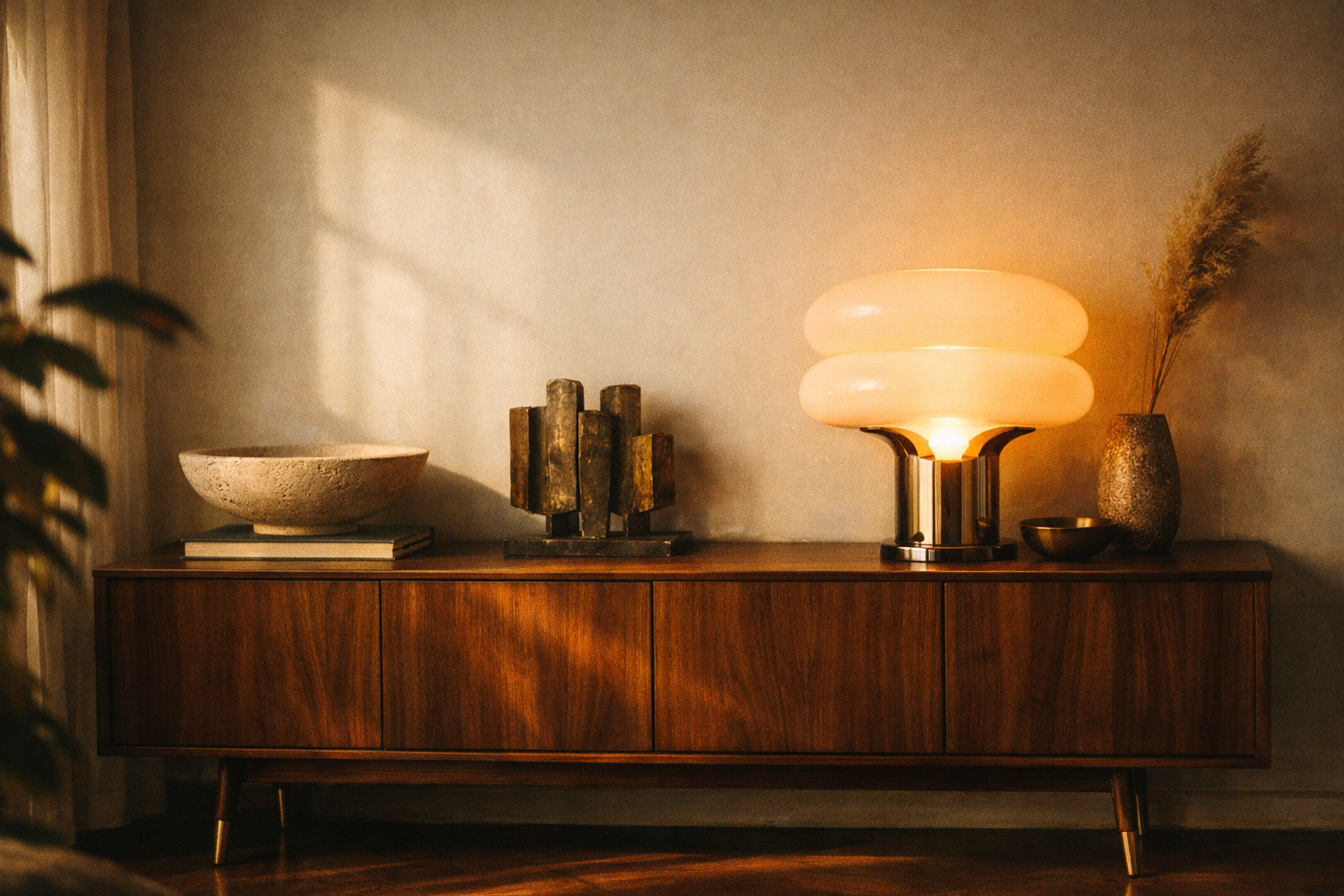
You're doing your usual browse at the thrift store — moving through the furniture section, half-expecting to find the usual assortment — when something stops you cold. A lamp. A chair. Maybe a sleek sideboard with legs so perfectly tapered they almost look too good to be here. Something about the weight of it, the line of it, the way the brass catches the light. Your gut says this is something. But what, exactly?
That moment — the suspended-breath, is-this-what-I-think-it-is moment — is one of the best things about thrift shopping. And knowing how to identify authentic Italian design is what turns that feeling from a guess into a confident, exhilarating score.
This guide is for anyone who's ever wondered. You don't need to be a collector or a design historian. You need five steps, a curious eye, and maybe fifteen minutes. Whether you're furnishing a Plateau walk-up or just falling deeper into the wonderful rabbit hole of vintage design, here's exactly what to look for.
Why Authentic Italian Design Is Worth Knowing About
Italy's design golden age — roughly the 1950s through the 1970s — produced some of the most celebrated, enduring furniture and lighting in the world. Designers like Gio Ponti, Marco Zanuso, Joe Colombo, and Mario Bellini weren't just making furniture. They were reshaping how people thought about objects, space, and daily life. The Artemide lamp. The B&B Italia sofa. The Cassina chair. These pieces are in museum collections and still showing up in thrift stores across Montreal — because they were made to last, and because decades of movement (immigration waves, estate sales, family downsizing) keep them circulating.
The beauty of finding one pre-loved? You're getting a genuine piece of design history at a fraction of what it would cost new or at auction — and you're giving it exactly the second life it deserves. That's the sustainable choice and the smart choice, wrapped in something that looks extraordinary in your home.
The Key Design Eras to Know
A quick cheat sheet before we dive into authentication:
1950s–60s: Post-war optimism meets elegant minimalism. Think walnut and teak, clean lines, functional beauty. Pieces from this era feel both timeless and warm.
1970s: Bolder, more experimental. Leather upholstery reaches new heights. Designers like Bellini and Scarpa pushed material boundaries — you'll see more curves, more drama, more personality.
1980s: The Memphis movement arrives — geometric, colourful, playful, and deliberately post-modern. Unmistakable if you know what you're looking at.
Step 1: Start With the Materials
The fastest, most instinctive authentication test is also the most tactile: pick it up and feel it.
Authentic Italian design is built with real materials. No particleboard. No peeling veneer. No hollow legs. The pieces were made by craftspeople who took material selection seriously — and it shows in your hands before it shows anywhere else.
Wood: Look for solid walnut, teak, rosewood, or cherry. These woods have weight, warmth, and a grain that catches the light in a way manufactured alternatives simply can't replicate. Run your hand along the surface. Solid wood has an unevenness — a life — that veneered or composite materials lack.
Brass hardware: Italian mid-century pieces love brass. Drawer pulls, table legs, lamp fittings — if the brass feels substantial in your hand and shows a golden patina (rather than peeling or looking plasticky), that's a good sign. Fake hardware is surprisingly light and often has a uniform, cheap sheen.
Leather upholstery: Authentic Italian leather is dense, soft, and unmistakably fragrant. Press your finger into it — genuine leather springs back slowly. It may show age lines and creasing, which is not a flaw. That's patina. That's character.
Murano glass: Found most often in lighting. Hand-blown Murano glass has visible irregularities — tiny bubbles, subtle variations in thickness, a depth that machine-made glass doesn't have. Hold it up to the light and look closely.
Step 2: Examine the Craftsmanship
Italian furniture artisans were trained in traditions that go back generations. That shows in the details — and it's exactly those details that reproductions consistently fail to replicate convincingly.
Joinery: Open a drawer. Look at the corners. Authentic pieces use dovetail joints — those interlocking, angled cuts that look like a dove's tail. They're strong, beautiful, and labor-intensive. Mass-produced furniture uses staples, dowels, and glue. The difference is immediately visible.
Symmetry and precision: Stand back and look at the piece as a whole. Panels should match. Grain should align across drawer fronts. Lines should be crisp where they're meant to be crisp, and fluid where they're meant to flow. Authentic Italian design is precisely intentional — nothing is slightly off.
Finishing details: Look at the underside. Flip it over if you can. Genuine pieces are finished underneath — you'll see sanded wood, consistent staining, careful attention even where no one is supposed to look. A rough, unfinished bottom is a red flag.
Upholstery construction: On chairs and sofas, check the seams. Fabric and leather should be pulled taut and tucked cleanly at every corner and edge. Authentic Italian upholstery rarely wrinkles, sags, or shows rough stitching.
One thing to be clear about: wear and patina are not signs of poor quality. Scratches on genuine walnut, a worn armrest on original leather — these are the marks of a life well-lived. They're part of the story. What you're screening for is sloppy construction, not honest aging.
Step 3: Hunt for Maker's Marks and Labels
This is the step most people skip — and it's often the most revealing. Italian manufacturers and designers were proud of what they made. Many pieces are marked. You just have to know where to look.
On furniture: Check the bottom of the piece, the back panel, and the inside of drawers. You're looking for paper labels, ink stamps, metal plates, or branded tags. Labels may be in Italian ("Fabbricato in Italia"), in English ("Made in Italy"), or simply carry a manufacturer name.
On lighting: Check the base of the lamp, the socket housing, and the cord or plug. Brands like Artemide, Arteluce, and Flos often marked their pieces directly on the fixture. Even a small embossed logo on the base is significant.
On upholstered pieces: Look beneath cushions, under the seat platform, or attached to the frame inside the upholstery. Some pieces have a fabric label sewn in; others have a metal or plastic tag riveted to the frame.
Names worth noting: Cassina, B&B Italia, Arteluce, Artemide, Zanotta, Poltrona Frau, Arflex, Molteni — if you see any of these, stop and pay attention. Even without a label, knowing the silhouettes and signatures of these manufacturers helps you recognize a piece on sight.
Don't be discouraged if there's no label — labels fall off, get painted over, and fade over decades. An absence of marking isn't proof of inauthenticity. It just means you rely more heavily on the other steps.
Step 4: Read the Design DNA
Even without a single label, authentic Italian design has a visual signature that becomes recognizable the more you look for it. This is the step that rewards experience — but anyone can start developing their eye right now.
Proportion: Italian mid-century design sits in a specific sweet spot. Not too heavy, not too delicate. A well-proportioned Italian chair feels visually balanced from every angle — the seat, the back, the legs all relate to each other with intention. Reproductions often get the individual elements right but miss the proportional relationship between them.
Line quality: In Italian design, every line earns its place. Curves are fluid and deliberate — not arbitrary. Angles are crisp where crispness serves the form. There's no ornamentation that doesn't have a reason to exist. If something feels fussy or over-complicated, that's a signal. If it feels effortlessly resolved — if the form seems inevitable — trust that instinct.
Material honesty: Italian design celebrates its materials rather than hiding them. Walnut grain is showcased, not stained into uniformity. Brass is polished but allowed to age. Leather develops a patina that improves the piece rather than diminishing it. If a piece seems to be hiding what it's made of, that's worth noticing.
A useful shortcut: look at photographs of verified pieces from the same era online, then look at your piece. You're not matching exact models — you're developing a feel for the language of the period.
Step 5: Do a Quick Provenance Check
For a piece that's passing all your tests and your pulse is starting to quicken, take two minutes to do a phone search before you walk away.
Pull up Google Images and search the designer name, the brand name, or a physical description: "Italian walnut credenza 1960s tapered legs" or "Artemide lamp brass 1970s." Look at what comes up. Does your piece share the same proportions, the same hardware details, the same design sensibility? A strong visual match is reassuring.
Platforms like 1stDibs, Pamono, and Catawiki are excellent references — they list authenticated pieces with production dates, designer attributions, and comparable pricing. If a near-identical piece is listed at $2,400 and you're looking at it in a thrift store, that's useful information.
Check production dates against what you're seeing. If a model was introduced in 1965 and your piece shows 1960s construction methods and materials, that's consistent. If something claims to be from 1960 but shows techniques or materials that didn't exist until the 1980s, that's a red flag.
This doesn't need to be a deep research exercise. A five-minute search on the spot is often enough to either confirm what you suspected or raise a question worth sitting with before buying.
What Authentic Italian Design Looks Like at EcoDepot
Here's the honest truth about shopping for Italian design in Montreal: it shows up. Regularly. An Artemide lamp surfacing in the Plateau. A teak credenza with perfect tapered legs in Lachine. A leather armchair whose silhouette makes you do a double-take. These trouvailles are real, and they happen more often than you'd think.
EcoDepot sees a genuinely diverse range of pieces come through every week — and because inventory turns constantly, checking new arrivals is always worth your time. The staff are genuinely knowledgeable about what comes in and happy to share what they know. If something catches your eye and you're not sure what you're looking at, ask. That's what the hunt is about.
The best part? When you find an authentic Italian design piece pre-loved, you're not just getting something beautiful. You're rescuing a piece of design history from being lost, bringing it into your home for a fraction of its market value, and extending the life of something made with extraordinary craft. That's a win for your space, your budget, and the planet — all at once.
Explore our vintage lighting collection for a taste of what we mean. Vintage Italian lamps alone are worth a visit.
The Eye Gets Better Every Time
Authentication isn't a gatekeeping skill for serious collectors. It's just looking closely — and looking closely is one of the great pleasures of thrift shopping. Every piece you examine teaches you something. Every authentic find you hold trains your hands to recognize the real thing faster next time.
The five steps — materials, craftsmanship, maker's marks, design DNA, quick provenance check — aren't a checklist so much as a way of paying attention. They deepen the experience of discovery rather than turning it into a chore. And occasionally, they're the difference between walking past a genuine mid-century Italian gem and taking it home.
Come find yours. We're at 1307 Mont-Royal Ave E on the Plateau and 187 Rue Richer in Lachine — open seven days a week. Follow us on Instagram @ecodepotmontreal for first looks at what just came in. The next trouvaille might already be waiting.