Chariot
0
Vintage furniture shopping offers some of the most rewarding finds for your home—unique pieces with character, sustainable choices that reduce waste, and prices that won't empty your wallet. But without knowing what to look for, it's easy to end up with pieces that cost more in repairs than they're worth, or worse, that end up back on the curb instead of becoming treasured additions to your space.
Here's the good news: most vintage furniture mistakes are completely avoidable once you know what to watch for. This guide reveals the eight most common pitfalls vintage shoppers encounter and exactly how to sidestep them. Whether you're furnishing your first Plateau walk-up or hunting for that perfect statement piece for your Mile End loft, these insights will help you shop with confidence and bring home pieces that truly deliver on the promise of sustainable furniture shopping in Montreal.
Mistake #1 – Prioritizing Aesthetics Over Structural Integrity
We've all been there. You spot a beautiful vintage armchair with the exact curved lines and button tufting you've been searching for. In your mind, you're already imagining it in your living room, bathed in afternoon light. But here's what often happens next: you fall so hard for the look that you forget to check whether the chair can actually, you know, be sat in safely.
This is the number one mistake vintage furniture shoppers make—letting aesthetics override function. Beautiful pieces trigger emotional buying decisions. We see how they'll transform our space and skip the crucial step of testing whether they're actually structurally sound.
How to Avoid This Mistake:
Before you commit to any vintage furniture purchase, run through these essential tests:
The Shake Test: Gently rock the piece side-to-side and front-to-back. A little movement is normal in older furniture, but excessive wobbling indicates serious joint issues. Chairs and tables should feel stable, not like they're about to collapse under normal use.
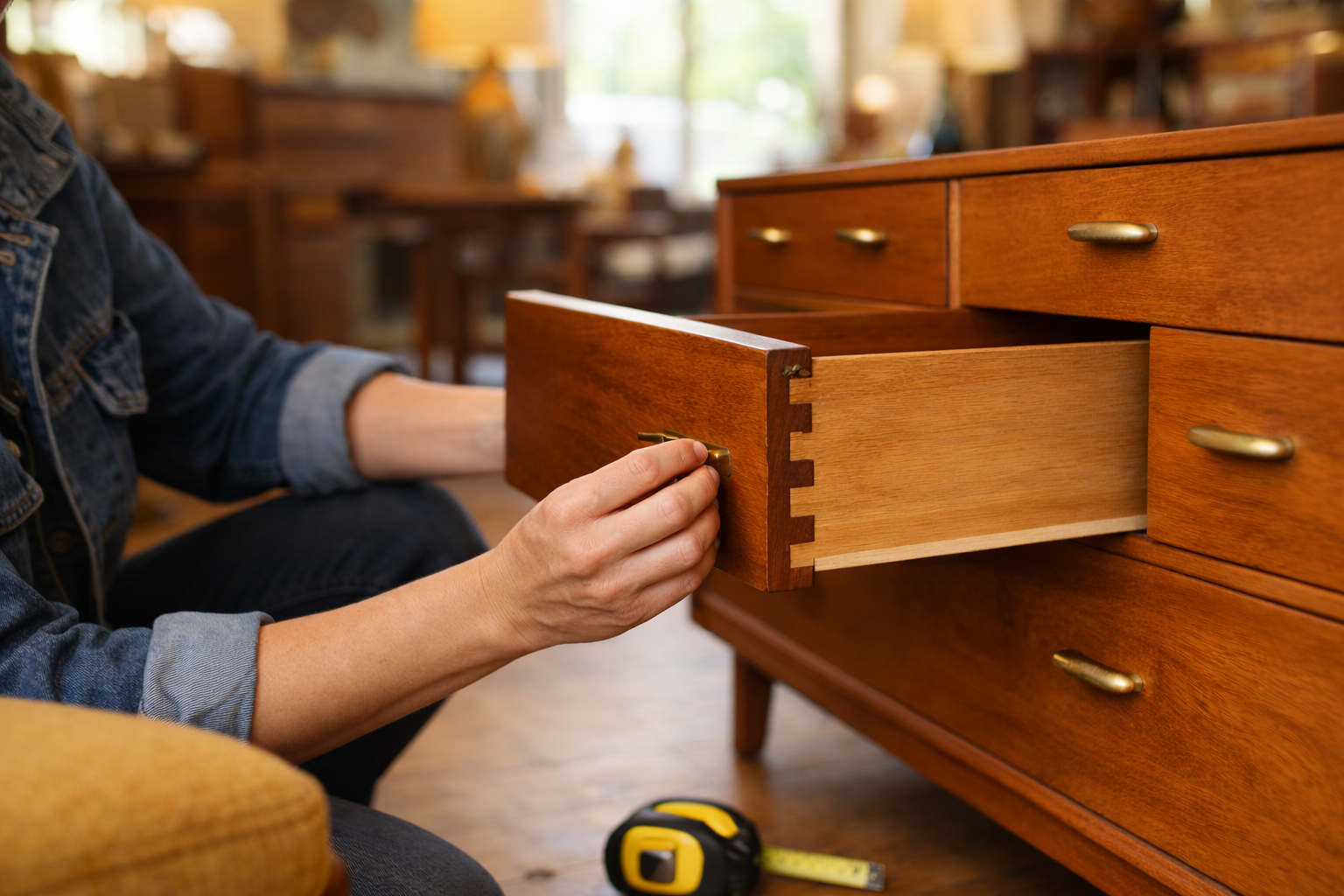
The Drawer Test: Open and close every drawer completely. They should glide smoothly without sticking, requiring excessive force, or falling off their tracks. Check that drawer bottoms are intact and secure—sagging or separated bottoms mean you'll be fishing items out from underneath the furniture.
The Weight Test: Sit on chairs, lean against tables, apply gentle pressure to shelving. Quality vintage pieces feel solid and substantial. If a chair creaks ominously when you sit down, or a table wobbles when you lean on it, that's your warning sign.
Joint Inspection: Look closely at where different parts connect. Dovetail joints (those interlocking "finger" patterns you see in drawer construction) are the gold standard—they indicate quality craftsmanship and will hold up for decades. Check that corner blocks inside tables and chairs are intact. Loose or missing blocks mean instability.
Leg Examination: Inspect where legs meet the body of the furniture. Look for cracks, gaps, or separation. Run your hand along the connection point—it should feel solid and smooth. Any movement or splitting at these crucial junctures will only get worse over time.
Here's something Montreal shoppers need to know: our climate is particularly hard on furniture. Winter heating dries out the air, while summer brings humidity. These seasonal swings cause wood to expand and contract, which can exacerbate existing structural issues. That minor wobble you notice in a heated shop in January might become a major problem by July.
Quality craftsmanship matters. As vintage experts point out, pieces with solid wood construction, proper joinery, and original hardware are built to last. These aren't just aesthetic details—they're functional ones that determine whether your find will serve you for years or need expensive repairs within months.
The bottom line: Don't let a gorgeous finish or perfect color blind you to structural red flags. Take the extra five minutes to thoroughly inspect every piece. Your future self (and your wallet) will thank you when you're still using that structurally sound vintage furniture a decade from now.
Mistake #2 – Ignoring the True Cost of Restoration
You find a vintage dresser with incredible bones—beautiful lines, solid wood construction, exactly the style you want. There's just one problem: the finish is trashed, two drawer pulls are missing, and there's some water damage on one side. "No big deal," you think. "I'll just refinish it myself!"
Three months later, that dresser is still sitting in your garage, half-stripped and mocking you every time you see it. Or worse, you've paid more to have it professionally restored than you would have spent buying a similar piece in good condition.
This is one of the most expensive mistakes vintage shoppers make: underestimating the true cost—in money, time, and skill—of restoration work. DIY optimism meets the "great deal" mentality, and we convince ourselves that repairs will be quick, easy, and cheap. They rarely are.
How to Avoid This Mistake:
Before buying any piece that needs work, get realistic about restoration costs:
The Professional Reality Check: Research what professional services actually cost in Montreal. Refinishing a table typically runs $300-$800. Reupholstering a single chair? Expect $400-$1,200 depending on fabric choice. Structural repairs start around $150 and can quickly climb to $500 or more for significant issues. These aren't inflated estimates—they reflect the skilled labor and materials required.
The 50% Rule: Here's a simple guideline that will save you from costly mistakes. If the restoration costs will exceed 50% of what you'd pay for a similar piece in good condition, think very carefully about whether it's worth it. Sometimes the answer is yes—for a truly unique or rare piece. Often, though, you're better off being patient and waiting for a better example.
DIY Reality Check: Be brutally honest about your skills, tools, and available time. Properly refinishing a dresser isn't a weekend project—it's 20 to 40 hours of work requiring proper ventilation, quality tools, sandpaper in multiple grits, stripper, stain, finish, and patience. Do you have all of that? Will you actually follow through, or will this become a guilt-inducing project that clutters your space for months?
Hidden Damage Detection: Before committing, check everywhere for problems that might not be immediately visible. Pull out drawers and look inside the cabinet body. Flip furniture over to check the underside. Look at back panels. Water damage, mold, pest infestations, or structural issues hiding in these less-visible areas can multiply restoration complexity and cost dramatically.
When Restoration Does Make Sense:
There are absolutely times when buying a piece that needs work is the right call:
-
You've found a genuinely unique or rare piece that isn't readily available elsewhere
-
It's a designer item where the restored value significantly exceeds the restoration cost
-
You have genuine DIY skills and have successfully completed similar projects before
-
The repairs needed are truly cosmetic and minor (replacing a drawer pull, touching up a small scratch)
-
The piece has sentimental value that justifies the investment
The key is going in with eyes wide open about what you're committing to. Get quotes before you buy. Map out the project realistically. And remember: there's no shame in walking away from a piece that would require more effort than it's worth.
Mistake #3 – Overlooking Provenance and Authenticity
"This is a genuine Eames chair," the seller tells you, pointing to a molded plastic chair at the flea market. The price—$200—seems like a steal for such an iconic piece. You're already imagining it in your home office. But here's the problem: without any maker's marks, documentation, or identifying features, you have no way to verify whether this is actually a vintage Herman Miller piece worth thousands, or a modern knockoff worth about $50.
Paying premium prices for pieces claimed to be from sought-after makers without verification is a mistake that costs vintage shoppers thousands of dollars every year. Sometimes sellers genuinely don't know what they have. Sometimes they misrepresent intentionally. Either way, if you're paying based on attribution rather than evidence, you're taking a big risk.
How to Avoid This Mistake:
Look for Maker's Marks: The first step in authentication is always checking for identifying marks. Flip furniture over, check the underside, look inside drawers, examine the back. Quality manufacturers stamped, labeled, or signed their work. Learn where these marks typically appear for the makers or eras you're interested in. A genuine Thonet bentwood chair will have the company stamp. A real mid-century Danish piece often has the designer's and manufacturer's marks clearly visible.
Research on the Spot: Your smartphone is your best friend when vintage shopping. See a maker's mark you don't recognize? Google it right there in the store. Unsure if a piece matches the claimed designer's style? Look up authenticated examples. Two minutes of research can save you from a costly mistake.
Document Everything: If you're considering a significant purchase, photograph all identifying marks, labels, and distinctive features before buying. This documentation serves multiple purposes: it helps you research authenticity, provides proof of provenance if you later sell the piece, and creates a record for insurance purposes.
Ask for Documentation: Don't be shy about requesting any paperwork, receipts, or provenance history the seller might have. Reputable dealers typically provide some documentation for valuable pieces. If someone is asking top dollar for a "designer piece" but can't provide any supporting evidence, that's a red flag.
Know Your Eras: Invest time in learning the distinguishing features of periods and styles that interest you. Mid-century modern furniture has characteristic hardware styles, specific wood types, and construction methods. Art Deco pieces feature distinct geometric patterns and materials. The more you know, the harder it becomes for someone to pass off a reproduction as the real thing.
Major Red Flags to Watch For:
-
Descriptions using "attributed to" or "in the style of" (these phrases mean the piece is NOT confirmed authentic)
-
No maker's marks on allegedly high-end pieces (legitimate manufacturers marked their work)
-
Suspiciously low prices for rare items (if it seems too good to be true, it probably is)
-
Sellers who can't answer basic questions about the piece's history or origin
Here's where shopping at established vintage stores offers real advantages. Places like EcoDepot and other reputable Montreal vintage shops often provide provenance information as a standard practice. Staff members typically have knowledge about the pieces they're selling and can answer questions about origins, makers, and authenticity. Don't hesitate to ask—that's what they're there for.
According to recent data, the Canadian pre-owned market has experienced significant growth, with more consumers embracing second-hand shopping as a mainstream trend. As the market expands, so does the presence of reproductions and misattributed pieces. Knowing how to verify authenticity protects your investment and ensures you're getting what you pay for.
The bottom line: When authenticity matters, verify before you buy. A genuine designer piece is worth the premium. A knockoff is not.
Mistake #4 – Buying Furniture That Doesn't Fit Your Space
You've found the perfect vintage sofa—gorgeous lines, impeccable condition, exactly what you've been searching for. There's just one tiny problem you discover when the delivery truck arrives: it won't fit up your staircase. Or through your doorway. Or around that tight corner in your third-floor Plateau walk-up.
This scenario plays out with frustrating regularity in Montreal, where narrow hallways, steep staircases, and tight corners are standard features of our beautiful old buildings. Buying furniture without measuring your space—or considering the journey from truck to room—is a mistake that can turn your exciting vintage find into an expensive lesson.
How to Avoid This Mistake:
Always Carry a Tape Measure: This is vintage shopping rule number one. Measure the piece you're considering. Measure all dimensions—height, width, depth. Don't estimate. Don't eyeball it. Actually measure. Then measure your intended space at home.
The Montreal Apartment Rule: Before you even start furniture shopping, measure your doorways (typically 32 inches wide in older buildings), hallways (often as narrow as 36 inches), and staircases. If you live in a walk-up—common in the Plateau, Mile End, and other central Montreal neighborhoods—measure the stairwell width, ceiling height, and identify any tight turns. Write these measurements down and keep them in your phone. You'll reference them constantly.
Visualize with Photos: When possible, photograph both the furniture piece and your space. Compare the proportions. This helps you envision scale in a way that measurements alone sometimes don't. A dresser might technically fit dimension-wise but still overwhelm a small bedroom visually.
Consider Disassembly Options: Before dismissing a piece as too large, ask if parts can be removed. Can legs unscrew? Does the back panel come off? Are there sections that separate? Many vintage pieces were designed to be somewhat modular for exactly this reason. Just ensure you or the seller knows how to properly reassemble everything.
Account for Functionality: It's not enough for furniture to fit in your space—you need room to actually use it. Ensure you have at least three feet of clearance in high-traffic areas and a minimum of two feet for furniture movement. Can you fully open dresser drawers without hitting the bed? Will the table leaves have room to extend? Can you walk around the sofa comfortably?
Pro Tips for Montreal Shoppers:
Keep a note in your phone with all critical measurements. Include room dimensions, doorway widths, stairwell measurements, and ceiling heights. Update it when you move. This five-minute investment saves countless "will it fit?" anxieties while shopping.
Take photos of your spaces to reference while browsing. Seeing your actual room while looking at furniture helps you make better decisions than relying on memory.
For walk-ups and tight spaces, prioritize furniture that navigates corners well. Look for pieces with removable legs, modular designs, or narrower profiles. A 30-inch-wide dresser is much easier to maneuver up a tight staircase than a 48-inch credenza.
Consider professional delivery for large pieces. Many Montreal vintage shops offer delivery services with staff experienced in navigating our challenging buildings. Yes, it costs extra, but it's worth it to avoid the nightmare of getting stuck on a landing.
The reality: Montreal's gorgeous old apartments come with spatial challenges. Plan for them instead of discovering them the hard way. Your back, your wallet, and your vintage furniture will all be better off.
Mistake #5 – Neglecting to Check for Pest Damage and Odors
There's something many vintage shoppers don't want to think about but absolutely must: the possibility that beautiful credenza might be hosting some unwanted tiny residents. Or that gorgeous upholstered chair might smell like its previous owner's chain-smoking habit every time your heating kicks on.
Bringing home furniture with hidden pest infestations or persistent odors is a mistake that ranges from mildly annoying to genuinely nightmarish. The problem is that we get visually distracted by aesthetics, feel embarrassed about thoroughly sniffing furniture in public, or simply don't know what warning signs to look for. Let's fix that.
How to Avoid This Mistake:
Pest Inspection Checklist:
Start by looking for tiny holes in the wood—these are exit holes from wood-boring beetles and typically measure 1-2mm in diameter. A few old holes aren't necessarily a deal-breaker if the infestation is long dead. But if you see fresh, clean holes alongside fine sawdust (called frass), you're looking at active insect activity. That's a hard pass.
Check for visible tunnels in any exposed wood, especially along edges and in less-finished areas like the undersides of tables or insides of drawers. Use your phone's flashlight to examine dark crevices and corners.
Here's an unusual but effective test: tap the wood gently and listen. Solid wood produces a solid sound. If you hear hollow, echo-y sounds in areas that should be solid, internal pest damage may have created chambers and tunnels. This is particularly important for larger pieces like dressers and cabinets.
Look for other evidence like tiny piles of sawdust, webbing (indicates moths if you're examining upholstered pieces), or actual insects. Check during daylight when you can see clearly.
Odor Detection:
Now for the less glamorous but equally important part: smell the furniture. Get close. Open drawers and really smell inside. Put your nose right up to upholstered sections. Yes, it might feel awkward, but you'll feel more awkward when your entire apartment smells like cigarette smoke or mildew.
Smoke: Cigarette and cigar smoke smells embed deeply into wood and upholstery. Even aggressive cleaning rarely eliminates it completely. When your heating runs or during humid summer months, the smell resurfaces. Unless you're prepared to live with it or invest in professional ozone treatment (which doesn't always work), walk away from heavily smoke-damaged pieces.
Mildew and Mold: That musty, damp smell indicates water damage and possible mold growth. This isn't just unpleasant—it's a health concern. Mold can continue growing and spreading, especially in Montreal's humid summers. If you smell it, you can be fairly certain it's present even if you can't see it. Not worth the risk.
Pet Odors: Similar to smoke, pet odors (particularly cat urine) are incredibly difficult to remove from upholstery and can soak into wood. Professional cleaning might help, but often these smells persist indefinitely.
Chemical Smells: Strong chemical odors might indicate recent treatments. Ask what was used. Some treatments are fine; others involve toxic chemicals you don't want in your home.
The Treatment Reality:
If you're considering buying a piece with pest issues, know what you're getting into. Active infestations require professional fumigation, typically costing $200-$500. The furniture needs to be isolated until treated, which means you can't use it right away.
Smoke odors persist despite your best cleaning efforts. Baking soda, vinegar, specialized products—they might reduce the smell, but it's rarely eliminated entirely. Ask yourself if you're willing to accept that reality.
Mold and mildew can continue spreading, particularly in areas with poor ventilation or high humidity. Once established, it's difficult to fully eradicate. The health risks often outweigh any bargain.
When to Walk Away:
-
Evidence of active pest infestation
-
Overwhelming odors of any kind
-
Visible mold growth, especially black mold
-
Multiple red flags combined (musty smell plus pest holes, for example)
The Safe Shopping Advantage:
This is where shopping at reputable stores really pays off. Established vintage shops like EcoDepot inspect and clean items before putting them out for sale. While you should still do your own inspection (always), you're far less likely to encounter serious pest or odor problems when buying from stores that have quality control processes in place.
The bottom line: A few minutes of careful inspection can save you from months of regret. Use your eyes, your nose, and your flashlight. Your future self will thank you.
Mistake #6 – Falling for "Vintage" Reproductions
The vintage furniture market has grown tremendously in recent years, and with that growth has come an influx of reproductions. Some are clearly marketed as new pieces inspired by vintage designs. Others? Not so honest. Walking into a flea market and paying vintage prices for mass-produced reproductions is a frustrating mistake that happens more often than you'd think.
Sometimes sellers genuinely don't know they're selling reproductions. Other times, they know exactly what they're doing. Either way, you need to protect yourself by learning how to tell the difference between authentic vintage and modern reproductions trying to pass as old.
How to Avoid This Mistake:
Construction Method Examination:
Real vintage furniture was built using methods and materials that differ significantly from modern mass production. Start by examining the construction.
Authentic vintage pieces use solid wood—maple, oak, teak, walnut, mahogany. Turn furniture over, check inside and underneath. You should see actual wood grain, not the uniform pattern of a veneer over particle board. Reproductions frequently use particle board, MDF, or cheap plywood with a thin decorative veneer applied.
Look at how pieces are joined together. Quality vintage furniture features dovetail joints, mortise-and-tenon construction, or sturdy wooden dowels. Reproductions rely on staples, cheap glue, and metal brackets. Examine drawer construction particularly carefully—those dovetail joints we discussed earlier are a hallmark of genuine craftsmanship.
Check the back panels of dressers and cabinets. Vintage pieces often have backs made of solid wood boards or quality plywood, sometimes with visible nail heads from age-appropriate fasteners. Modern reproductions typically have thin cardboard or flimsy stapled panels.
Wear Pattern Analysis:
Authentic vintage furniture shows wear in logical places based on decades of use. Look for worn spots on chair arms where hands naturally rest, slightly faded areas on drawer fronts from repeated opening and closing, gentle scuffing on table edges, and slight unevenness on surfaces that have been genuinely used and loved.
Artificial distressing, by contrast, looks uniform and intentional. It often appears in places that wouldn't naturally wear—like the middle of a table top rather than the edges, or randomly distributed "age marks" that don't follow use patterns. If the wear seems too perfect or too evenly distributed, you're probably looking at artificial aging.
Hardware Investigation:
Original hardware on vintage pieces shows genuine age-appropriate wear. Brass develops a natural patina that's difficult to fake convincingly. Screws and bolts show authentic oxidation patterns. Pull handles have wear marks from decades of fingers gripping them.
Reproduction hardware tries to mimic this but often falls short. You'll see perfectly shiny screws with artificial "aging" that looks painted on, or hardware that's uniformly "distressed" rather than showing the natural variation real age creates.
The Price Point Test:
If something seems too cheap for genuine vintage, trust your instincts. A real Eames chair doesn't sell for $200. Authentic mid-century Danish modern pieces command specific price ranges. Yes, occasionally you find an incredible deal because a seller doesn't know what they have—but that's rare. More often, the too-good-to-be-true price reflects what the item actually is: a reproduction.
Material Red Flags:
Watch for these specific warning signs:
-
Particle board or MDF in pieces claiming to be from eras before these materials existed or were commonly used
-
Plastic components pretending to be Bakelite or wood
-
Screws instead of appropriate age-consistent fasteners in pieces marketed as antiques
-
Perfectly uniform "patina" or "distressing" that looks applied rather than earned through use
Research Before You Buy:
Take time to learn what authentic pieces from your target era actually look like. Join online vintage furniture groups where members share knowledge. Study museum examples and verified auction results. The more familiar you become with authentic pieces, the easier it becomes to spot reproductions.
Compare what you're examining to verified examples. If something feels off—the proportions aren't quite right, the materials seem wrong, the construction doesn't match what you've seen in authenticated pieces—trust that instinct and investigate further.
The Montreal Context:
With vintage furniture growing increasingly popular in Montreal, reproductions have become more common at flea markets and casual selling venues. Weekend markets, in particular, tend to have a mix of genuine vintage and modern reproductions. Knowing how to differentiate protects your investment and ensures you're getting what you pay for.
The bottom line: Authentic vintage furniture is built differently, ages differently, and costs accordingly. Learn the signs, do your research, and don't let excitement override careful examination.
Mistake #7 – Not Considering Long-Term Care Requirements
You fall in love with a vintage leather sofa. The rich patina, the worn-in comfort, the perfect mid-century lines—it's everything you wanted. What you didn't consider: leather requires regular conditioning, is vulnerable to drying and cracking, and might not survive well with your two cats who view furniture as their personal scratching posts.
Buying furniture without understanding its maintenance needs or how it fits with your actual lifestyle is a mistake that turns dream pieces into sources of stress and disappointment. The problem? We focus entirely on acquisition and forget to think about the ongoing reality of ownership.
How to Avoid This Mistake:
Ask Critical Questions Before Buying:
What's the finish type? Does the piece have its original finish, which might require special care products and techniques? Has it been refinished with modern polyurethane that's more forgiving? Untreated wood needs regular oiling. Shellac finishes are alcohol-sensitive. Lacquer scratches easily. Know what you're committing to.
What are the material vulnerabilities? Different materials have different needs. Leather needs conditioning every 3-6 months or it dries and cracks. Marble stains easily—wine, coffee, and acidic substances can permanently mark it. Untreated wood responds dramatically to humidity changes, swelling in summer and contracting in winter. Understand the specific vulnerabilities of your potential purchase.
Does it fit your lifestyle? Be honest about your life. Do you have pets? Small children? Do you entertain frequently? Eat meals on your sofa? A delicate gilded table isn't practical for a household with toddlers. White upholstery and wine-loving dinner parties don't mix well. There's no shame in choosing furniture that matches your reality rather than your aspirations.
Are you willing to commit to maintenance? Vintage furniture often requires more care than modern pieces. Ask yourself honestly: will you actually oil that teak credenza twice a year? Condition that leather quarterly? Avoid placing hot items on that unprotected wood surface? If the answer is "probably not," choose pieces with lower maintenance requirements.
Care Commitment Levels:
Low Maintenance pieces include furniture with sealed or refinished wood surfaces, laminate finishes, powder-coated metal, and simple, washable upholstery fabrics. These are practical choices for busy lifestyles, households with children or pets, or people who simply don't want furniture ownership to feel like a part-time job.
Medium Maintenance items feature original wood finishes that need periodic oiling (1-2 times yearly), painted pieces that might need gentle cleaning and eventual touch-ups, and standard upholstery that should be vacuumed regularly and professionally cleaned every couple of years.
High Maintenance pieces demand more: leather requiring quarterly conditioning, marble needing immediate cleanup of spills and periodic sealing, gilt or delicate finishes requiring specialized cleaning products and gentle handling, and intricate veneers vulnerable to humidity changes and requiring careful climate control.
Montreal Climate Considerations:
Our city's dramatic seasonal swings create specific challenges for vintage furniture. Montreal winters mean dry indoor air from heating systems, which can cause unsealed wood to crack and leather to dry out faster than normal. If you're serious about protecting valuable vintage pieces, a humidifier isn't just nice—it's necessary.
Summer brings the opposite problem: humidity. This can affect certain finishes, cause wood to swell, and create conditions where mold might develop on vulnerable materials. Dehumidifiers help, as does air circulation and avoiding placing furniture directly against exterior walls.
Temperature fluctuations near windows affect some vintage pieces. That beautiful spot with natural light might cause finishes to fade or wood to expand and contract more dramatically. Consider furniture placement carefully, especially for valuable or delicate pieces.
The Honest Self-Assessment:
Here's the key question: Do you want low-maintenance living or are you genuinely willing to care for higher-maintenance pieces? Neither answer is wrong. Some people love the ritual of furniture care—treating it as meditation, as connection with their belongings, as part of the whole vintage furniture experience. Others just want functional, beautiful furniture that doesn't require scheduling care into their calendars.
Be honest with yourself about which camp you're in. If you prioritize convenience and ease, choose accordingly. There are plenty of gorgeous vintage pieces with sealed finishes, durable materials, and forgiving maintenance requirements. You can absolutely embrace sustainable vintage shopping without signing up for intensive furniture care routines.
The bottom line: Understand what you're buying before you buy it. Ask about care requirements. Research the specific materials and finishes. Then honestly assess whether you'll actually follow through with the necessary maintenance. The most beautiful vintage piece becomes a source of guilt and stress if its care requirements don't match your lifestyle.
Mistake #8 – Impulse Buying Without Research
You're browsing a vintage shop when you spot a credenza that seems perfect. The seller mentions another person was interested yesterday, and you feel that familiar flutter of fear—what if someone else buys it first? What if you never find another one like it? Before you know it, you've committed to a purchase without researching fair market value, comparing prices elsewhere, or even being certain it fits your space.
Making snap decisions without knowing fair market value or exploring comparable options is perhaps the most common vintage furniture mistake. Fear of missing out drives us to act fast. Emotional attachment clouds judgment. High-pressure sales situations (even unintentionally created ones) push us to decide before we're ready.
How to Avoid This Mistake:
Develop a Smart Shopping Strategy:
Do Preliminary Research: Before you even start shopping, research current prices for the types of items you're seeking. Check eBay's sold listings (not just current auctions—what actually sold tells you real market value). Browse 1stDibs to understand high-end pricing. Look at local comparable stores to gauge Montreal market rates. This baseline knowledge prevents you from wildly overpaying or, conversely, missing out on genuine bargains.
Implement the 24-Hour Rule: For any significant purchase—let's say anything over $200—give yourself at least one night to sleep on it. If the piece is truly special and the price is fair, it's worth holding for a day while you make a thoughtful decision. If the seller won't hold it, that might tell you something about the "deal" you're getting.
Comparison Shop Across Montreal: Don't buy the first example you see unless it's genuinely rare. Visit multiple venues—EcoDepot, Village des Valeurs, local antique dealers, weekend markets. Understanding the range of available options and prices helps you recognize when you've found something special versus when you're about to overpay for something common.
Set a Budget Before Shopping: Know your maximum spending limit before you walk into a store. Include not just the purchase price but also transport costs and potential restoration expenses. It's much easier to stick to a budget when you've defined it in advance rather than making up numbers in the moment while staring at something you want.
Ask About Hold Policies: Many shops, including EcoDepot, offer short hold periods while you make a decision. There's no shame in asking, "Can I put this on hold until tomorrow while I measure my space?" or "Could you hold this for 24 hours while I think it over?" Reputable sellers understand that thoughtful buyers often become repeat customers.
Price Negotiation Tips:
In vintage furniture shopping, unlike retail, prices are often negotiable. Here's how to approach it professionally:
Point out specific damage or needed repairs politely and factually. "I noticed this drawer front has some veneer damage. Would you consider $X given that repair cost?" This is far more effective than "This is damaged so I'll give you half price."
Ask if there's any flexibility on the price, especially for cash purchases. Sometimes sellers have wiggle room they'll use for serious buyers. The worst they can say is no.
Bundle multiple items for better overall pricing. "I'm interested in this chair and that side table. If I take both, could you do $X total?" Sellers often prefer moving multiple pieces at slightly reduced per-item prices.
Pay attention to timing. End-of-season sales, holidays, and especially Montreal's moving season around July 1st often bring better deals as sellers make room for new inventory.
When Fast Action Is Justified:
There absolutely are times when you should act quickly:
-
You've found a genuinely rare or unique piece at a fair price and you've been specifically searching for exactly this item
-
It's a designer piece you can authenticate on the spot, and it's priced well below market rate
-
You've done your research in advance and know that this specific item at this price is excellent value
The difference between smart fast action and impulse buying is preparation. If you've done the research beforehand, know the market, and recognize genuine value when you see it, acting quickly is smart shopping. If you're deciding on the spot without context or knowledge, that's impulse buying.
FOMO Management:
Here's a truth that will save you money and stress: there's always another great find coming. Vintage furniture shopping isn't like buying concert tickets to a sold-out show. New pieces constantly enter the market. EcoDepot gets fresh inventory weekly. Estate sales happen regularly. People are always selling vintage furniture online.
Yes, you might miss out on a specific item. But another wonderful piece will come along. The mindset shift from "I must have this or I'll never find anything like it" to "This is one option among many" makes you a better, more strategic shopper.
Montreal Shopping Seasons:
Understanding local timing helps you shop strategically. Montreal's legendary July 1st moving day brings a surge of furniture listings as people downsize, relocate, or change their style. This is prime hunting season—both for volume of available items and for deals as sellers try to avoid moving pieces.
Post-holiday periods, particularly January, often bring good deals as people clear out gifted items they don't want or make room for holiday acquisitions. Back-to-school season in late August can also be productive as students furnish apartments and recent graduates clear out previous furniture.
The bottom line: Strategic shopping beats impulse buying every time. Do your research, set your budget, take your time, and remember that patience often rewards you with better finds at better prices than FOMO-driven snap decisions ever will.
Bringing It All Together
Learning to shop for vintage furniture wisely is exactly that—a learning process. Every vintage furniture enthusiast has made at least a few of these mistakes. The ones who become savvy shoppers aren't the ones who never make errors; they're the ones who learn from them and develop better strategies.
Avoiding common vintage furniture mistakes fundamentally comes down to three things: thorough inspection, honest research, and realistic self-assessment. Take the time to really examine pieces before buying. Do your homework on pricing, makers, and care requirements. And be truthful with yourself about your skills, your space, and your commitment to maintenance.
The most successful vintage furniture shoppers develop a methodical approach. They carry tape measures. They've researched the styles and eras they love. They know their local market. They inspect carefully. And they're willing to walk away from pieces that don't meet their standards, no matter how beautiful they are, because they trust that better options will come along.
This is where shopping at curated vintage stores like EcoDepot offers real advantages. When you visit our Lachine or Plateau locations, you're shopping from inventory that's already been inspected for quality and structural integrity. Our team documents provenance when available and can answer questions about pieces' origins, construction, and care requirements. We help you avoid many of the common pitfalls by doing preliminary quality control and providing knowledgeable guidance.
That doesn't mean you shouldn't still inspect pieces yourself—you absolutely should, using the guidelines in this article. But it does mean you're starting from a stronger position, shopping from pre-vetted inventory rather than completely unknown quantities.
Every piece of vintage furniture has a story—where it came from, who made it, who owned it before you, what events it witnessed. When you buy thoughtfully, avoiding the common mistakes we've discussed, you're adding your chapter to that story. You're making a choice that's sustainable, affordable, and unique. And you're bringing home a piece that will serve you well for years, maybe decades to come.
Visit us at EcoDepot Montreal to explore our weekly-rotating selection of quality vintage furniture. Whether you're furnishing your first apartment or adding a statement piece to an established home, our team is here to help you shop confidently and avoid costly mistakes. Because the best vintage furniture finds aren't just about getting a good deal—they're about finding pieces that truly belong in your space and your life.
The treasure hunt for perfect vintage furniture is genuinely half the fun. Armed with these insights, you're ready to shop with confidence, make informed decisions, and bring home pieces with real staying power. Happy hunting!