Chariot
0
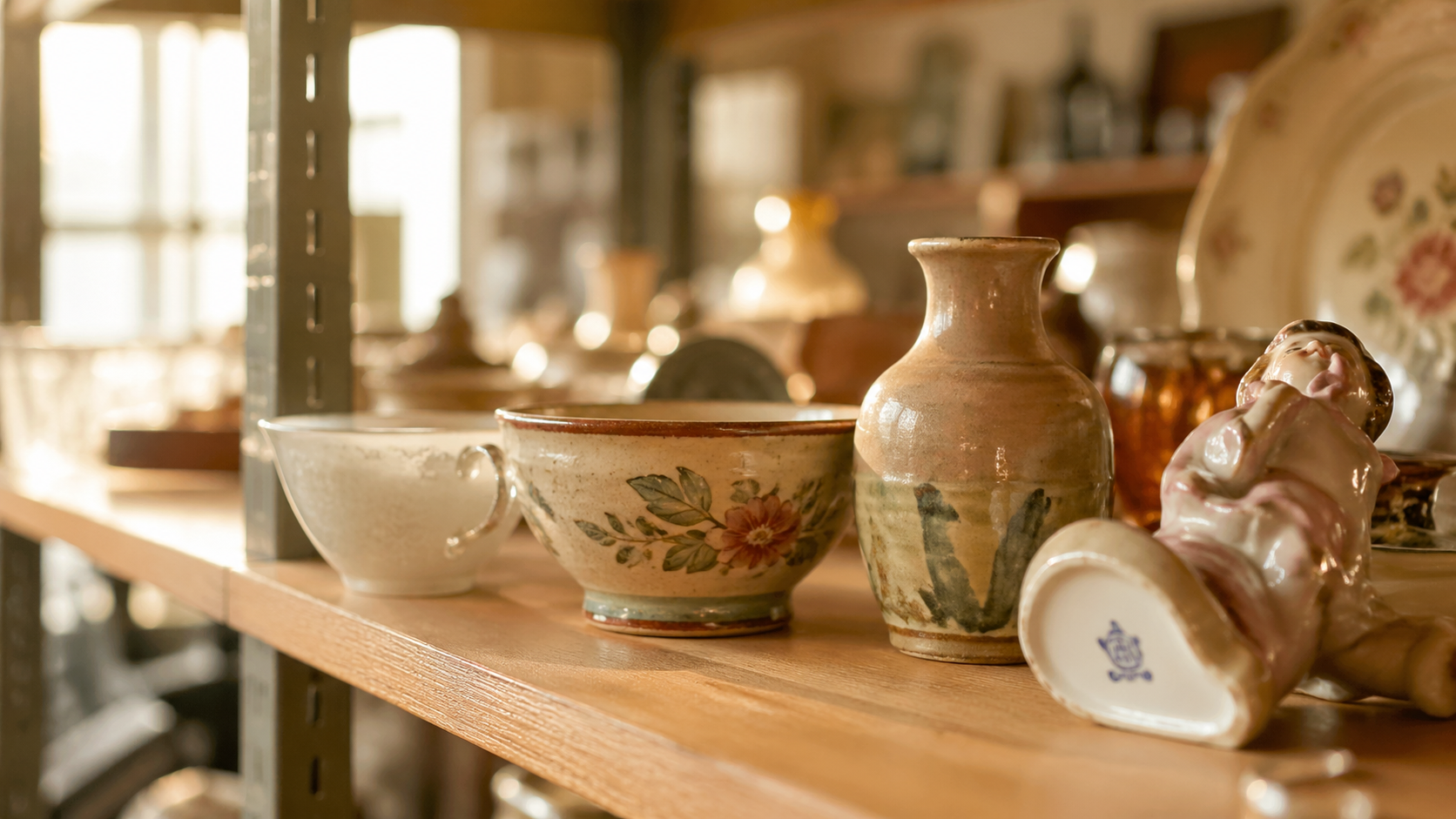
You reach for a plain white bowl at a thrift store. It looks like nothing special — a bit dusty, $3.99 sticker on the side. Then you flip it over. There's a mark on the bottom you don't recognize, and something about the weight of the piece in your hand feels different. Good different. That moment? That's what learning how to identify valuable porcelain actually feels like in practice.
Here's what most thrift shoppers don't realize: the difference between a $4 piece and a $400 piece often comes down to a few simple checks you can do right there in the aisle, no art history degree required. And in Montreal, where estate donations bring waves of interesting pieces through stores every week, the ceramics shelf is one of the best places to find a genuine trouvaille.
This guide walks you through six practical steps to identify quality and value in vintage ceramics and porcelain at thrift stores — the same habits that turn a casual browse into a real discovery.
Porcelain vs. Pottery vs. Ceramics: What's the Difference?
Before you can identify valuable pieces, it helps to know what you're actually looking at. "Ceramics" is the umbrella term — it covers everything made from clay and hardened by heat. Under that umbrella, there are three main types, and they're not created equal in terms of value or collectibility.
• Earthenware: The oldest and most common type. Fired at lower temperatures, it stays slightly porous without glaze. Think terracotta pots and rustic folk pottery. Beautiful, but generally the most affordable of the three.
• Stoneware: Denser and more durable, fired hotter. Great for everyday dishes. Often found in abundance at thrift stores — and sometimes hiding gems from well-known makers.
• Porcelain: The most refined and, typically, most valuable of the three. Made from kaolin clay and fired at very high temperatures, it's known for its translucency, white colour, and surprisingly delicate appearance despite real strength.
The quick porcelain test: Hold the piece up to a light source. If it glows with a soft translucency, you're likely holding porcelain. Also notice the temperature — porcelain feels noticeably cooler to the touch than stoneware of similar size, and lighter too.
Step 1 — Flip It Over: Reading Maker's Marks
This is the single most important habit you can build. The bottom of a piece tells you more than the front. Always flip it over before you do anything else.
Maker's marks can include signatures, logos, backstamps, country of origin text, date codes, or design numbers. Even a single word or symbol can open up a world of research. Here's what to look for:
• Backstamps and logos: Well-known names like Wedgwood, Limoges, or Meissen are relatively easy to spot.
• Country of origin: "Made in Occupied Japan" (1945–1952) automatically flags a piece as historically collectible. "Made in England" on certain pieces points to 19th or early 20th century production. "Czechoslovakia" predates 1993. These small phrases carry big information.
• Paper labels vs. fired-in marks: A fired-in backstamp (baked into the glaze) is more reliable than a paper label, which can be added later. If there's a paper label, check whether it matches the apparent age of the piece.
• Quebec and Canadian pieces: Estate donations in Montreal sometimes carry French Canadian pottery marks worth knowing — including pieces from studios active during the Québécois arts and crafts revival of the 1960s and 70s. Handwritten or stamped marks from Canadian studio potters can indicate genuine artisan work.
Step checkpoint: If the bottom has any marking at all, pause and photograph it before moving on. Research later at home, without the pressure of the aisle.
Step 2 — Use Your Hands: Weight and Balance
Your hands are one of your best research tools. Before you look at anything visually, just hold the piece.
Quality ceramics have a particular feel. The walls should be even — no thick clunky sections in one area and unexpectedly thin ones in another. The weight should feel intentional: not hollow-light like cheap mass production, and not brick-heavy either. Pick it up and let it settle in your palm for a moment.
• Balance test: Set the piece down. Does it sit flat and stable? Does it feel secure? Unsteady or top-heavy pieces often point to lower-quality manufacturing or damage.
• The foot rim: Flip it and look at the ring that actually contacts the table. On older pieces, you'll often see smooth, softened wear at the edges from decades of use. Sharp, fresh-feeling edges on a supposedly "vintage" piece can be a sign it's a reproduction or a newer piece priced as old.
• Even thickness: Run your thumb and index finger along opposite sides. Consistent wall thickness is a mark of skilled craftsmanship — and usually a better sign for quality and value.
Step checkpoint: If the piece feels "off" in your hand — awkward, unbalanced, or strangely hollow — trust that instinct and keep looking.
Step 3 — Listen: The Tap Test
This one is quick, satisfying, and more useful than it sounds. Gently tap the rim of the piece with your fingernail.
Porcelain and well-fired stoneware produce a clear, ringing sound — almost bell-like. Lower-quality clay or mass-produced pieces give a dull, flat thud. And here's the bonus: a dull sound on a piece that looks and feels otherwise solid can indicate a hidden hairline crack not yet visible to the eye. That crack will affect value significantly.
This test is especially useful when you're looking at a piece with surface glaze crazing (the fine network of small cracks you often see on older ceramics). Crazing is normal aging — it's not damage. But a piece that both crazes visually AND sounds dull when tapped may have more structural compromise than it appears.
Step checkpoint: One clear ring and you're in business. A flat thud means dig deeper before you commit.
Step 4 — Examine the Surface: Glaze, Design, and Age Signals
Now slow down and really look at the piece. The surface tells a story if you know what to read.
Hand-Painted vs. Transferware
Was the design applied by hand or printed? Modern transferware is nearly perfect — crisp, uniform, no variation. A vintage hand-painted piece shows the opposite: slight variation in colour, visible differences in stroke pressure, and a sense of human touch. That imperfection is actually a signal of value, not a flaw.
Glaze Crazing: Age, Not Damage
That fine network of tiny surface cracks you see on older ceramics? That's crazing — caused by the clay body and glaze contracting at different rates over decades. It's normal and expected on genuine antique and vintage pieces. It doesn't affect structural integrity, and it's often a good sign you're holding something with real age.
Colour as a Clue
Certain pigments were used in specific eras. True cobalt blue, iron red, and certain muted earth tones appear in particular periods of production. If a piece's colours look suspiciously bright and modern despite a supposedly old style, look more carefully.
What to Pass On
Hairline cracks that go through the clay body — not just the surface glaze — are a genuine concern. For decorative pieces, a through-crack reduces value significantly. For functional pieces like plates and cups you plan to use for food, pass entirely: those cracks can harbour bacteria and the piece may not be food-safe.
Step 5 — Names Worth Stopping For
You don't need to memorize an encyclopedia. But a few names are worth knowing well enough to pause when you spot them on a shelf.
• Limoges: Fine French porcelain with a long production history. Look for "Limoges France" on the bottom. Pieces with hand-painted decoration and gold detailing can be especially valuable.
• Meissen: German porcelain marked by two crossed blue swords. One of the most collectible European porcelain marks in the world.
• Wedgwood: English pottery and porcelain, including the iconic blue-and-white Jasperware. The word "Wedgwood" should appear clearly on the base.
• McCoy: American art pottery from the early-to-mid 20th century. Known for its folk-art charm, earthy glazes, and collectible appeal.
• Royal Copenhagen: Danish porcelain with a distinctive blue-and-white style. Marked with three wavy lines.
• Canadian studio ceramics: Handmade pieces from Quebec and Canadian studio potters of the 1960s–80s are increasingly collectible. Handwritten signatures or small workshop stamps are worth researching.
Not sure what you're looking at? Don't scroll endlessly in the aisle. Photograph the mark, set the piece down safely, and research it at home. You can always go back the next visit if it's still there — and sometimes, that's part of the game.
Step 6 — The Condition Check: What to Accept, What to Leave
Perfection isn't the goal. Knowing what matters is.
Acceptable
• Glaze crazing (surface aging, not structural damage)
• Light surface scratches from normal use
• Minor staining that may be removable with gentle cleaning
• Patina — that beautiful, authentic quality that only comes with real age
Pass On
• Cracks through the clay body, not just the glaze surface
• Missing chips on functional pieces (plates, cups) intended for food use — food safety concern
• Obvious repair work with visible glue or filled areas — unless the price reflects it
The decorative vs. functional rule: A chipped decorative vase can still be beautiful and worth buying for display. A chipped plate is a different story. Know what you're buying it for, and let that guide your standards.
If you're considering a more significant investment, a small UV flashlight (there are phone apps that approximate this) can reveal professional restoration work — repairs that aren't visible to the naked eye under normal light will often glow differently under UV.
Where to Practice These Skills in Montreal
The ceramics shelf is one of the highest-turnover areas at any thrift store — new pieces arrive constantly, rotating in from estate donations and drop-offs throughout the week. In Montreal, that means a genuinely unpredictable mix: Quebec estate pieces, European porcelain that came over with immigrant families, Canadian studio pottery from the 60s and 70s, and the occasional designer find hiding behind a row of everyday mugs.
At EcoDepot Montreal, ceramics move through both our Lachine and Plateau locations regularly. Our inventory refreshes every week, with new arrivals flowing in from across the city — which means the shelf you checked last Thursday might look completely different this Thursday.
Shopping tips for ceramics at EcoDepot: Thursday and Friday tend to bring fresh inventory to the floor. Always check the bottom shelf and the back of shelves — that's where pieces get tucked in and overlooked. If you're hunting for something specific, it's worth making a habit of dropping by often. The best finds don't wait.
Montreal's bilingual character shows up beautifully in the ceramics that cycle through — French Canadian pottery, European pieces brought over by Québécois and immigrant families, and the occasional mid-century studio gem that someone's grandmother kept safe for decades. Every piece has a story. Learning to identify valuable porcelain is really just learning to read those stories.
Ready to Hunt? Here's Your Quick Checklist
Six steps, and they take about two minutes once you've practiced them a few times:
• Flip it: Check the bottom for maker's marks, backstamps, country of origin
• Feel it: Even wall thickness, intentional weight, stable balance, worn foot rim
• Tap it: Clear ring = good sign; flat thud = hidden crack or lower quality
• Read it: Hand-painted or transfer? Glaze crazing? Age-appropriate colours?
• Recognize it: Know a handful of names worth pausing for (Limoges, Meissen, Wedgwood, Canadian studio marks)
• Condition check: Crazing is fine; through-cracks and chips on functional pieces are not
Every thrift run is practice. The more pieces you pick up, tap, and flip over, the faster your eye develops. You'll start recognizing quality from across the aisle before you even reach the shelf. That's when thrifting ceramics stops being a guessing game and starts feeling like a genuine skill.
New ceramics arrive at EcoDepot Montreal every week at our Lachine and Plateau locations. Come put your new skills to work — and see what's waiting on the shelf. You never know when the next trouvaille is hiding right in front of you.