Chariot
0
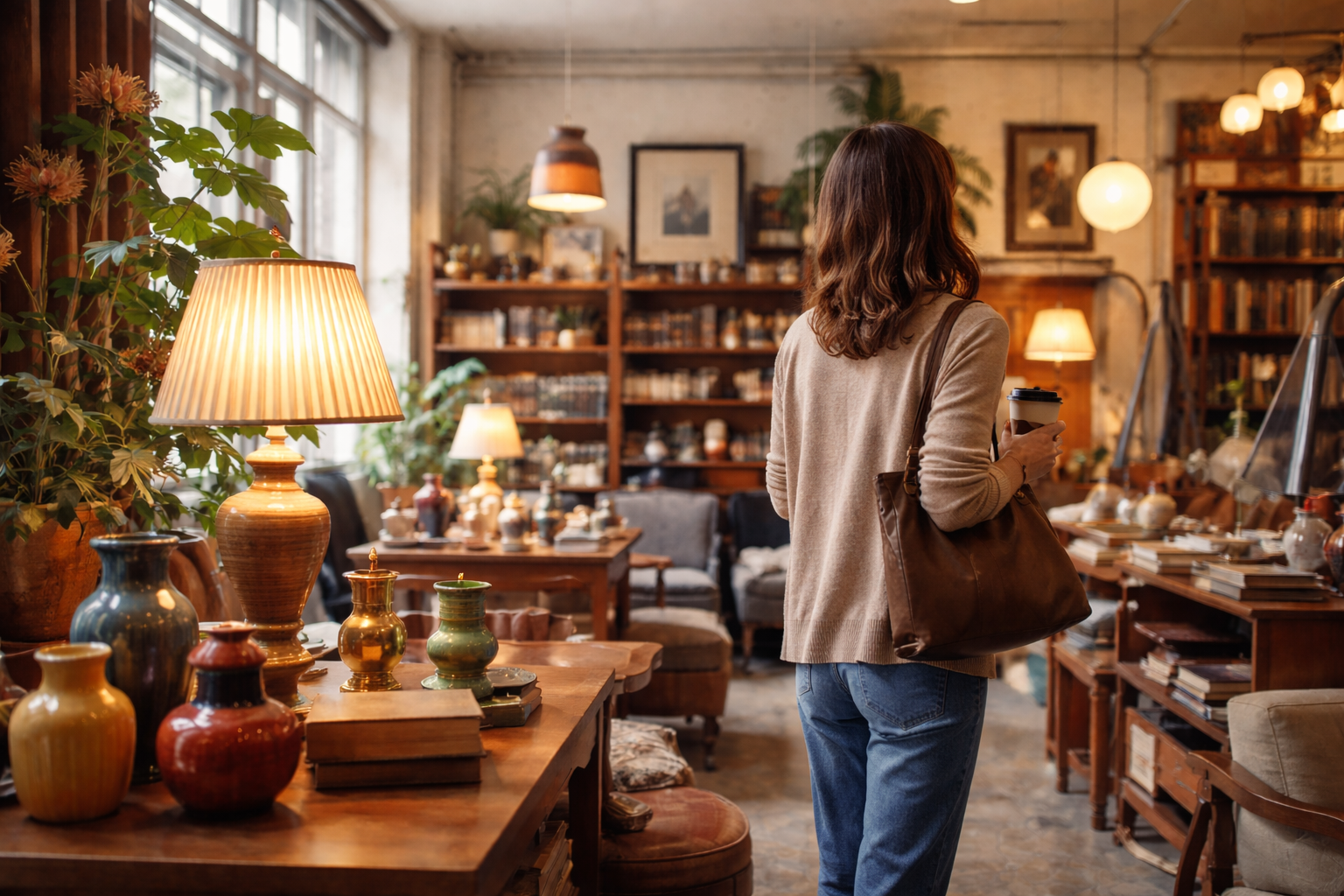
You weren't looking for anything in particular. Maybe you wandered in on a slow Saturday, coffee in hand, with no real agenda. Then, somewhere between the vintage lamps and the mid-century credenzas, something catches your eye. A brass fixture. A teak side table. A ceramic bowl in exactly the right shade of forest green. Your heart does a little thing. You reach for it.
Sound familiar? That feeling has a name — and it's rooted in real psychology.
Thrift shopping has quietly evolved from a budget necessity into one of the most psychologically rich retail experiences available. In Montreal, it's practically a cultural institution: wandering the quartiers, turning corners, discovering trouvailles that tell stories older than the store itself. But what's actually happening in our brains during that moment of discovery? Why does scoring a pre-loved find feel so much more satisfying than clicking "add to cart"?
Here's a deep dive into the real science — and the very human instincts — behind why thrift shopping feels so extraordinarily good.
Your Brain on the Hunt: The Dopamine Effect
It starts with chemistry. When you stumble across something unexpected and wonderful while thrift shopping, your brain releases dopamine — the neurotransmitter associated with pleasure, reward, and motivation. The same chemical that fires when you achieve something meaningful, enjoy a great meal, or hear a song you love.
But here's what makes thrift shopping particularly potent: the reward is unpredictable. Behavioral psychology tells us that variable rewards — ones that arrive at random, not on a schedule — trigger stronger dopamine responses than predictable ones. This is the same mechanism behind a great slot machine. But instead of pulling a lever, you're rounding a corner. Instead of flashing lights, you're finding a 1970s Italian lamp that belongs in your living room.
Unlike conventional retail, where inventory is curated, consistent, and endlessly restockable, a thrift store never has the same merchandise twice. You don't know what you'll find — and that not-knowing is precisely what makes it electric. Each visit is its own small adventure with a genuinely uncertain outcome.
That's not an accident. That's your brain doing exactly what it was designed to do: seek, anticipate, discover, and reward.
The Effort Justification Effect: Why Thrifted Finds Feel More Valuable
There's a well-documented phenomenon in behavioural psychology called the "effort justification effect." In simple terms: the harder we work for something, the more we value it.
This explains why a $30 thrifted chair can feel more satisfying than a $300 mass-produced one. You spent time finding it. You dug through a row of mediocre options. You recognized something good before anyone else did. That investment — of time, attention, expertise — becomes woven into the object itself.
And then there's the story. Every thrifted find comes with one. "I found this at EcoDepot on a rainy Tuesday in November" is not just a memory — it's a narrative that makes the object richer, more personal, and genuinely one-of-a-kind. When you walk into a chain store and pick up one of 500 identical cushions, there is no story. There is only a transaction.
Thrift shopping transforms every purchase into something earned, and everything earned into something worth keeping.
Identity and Individuality: Thrifting as Self-Expression
Walk into almost any conventional retailer, and you're being curated at. The merchandisers have decided what's trending, what's displayed, and what you're supposed to want. Everything is organized to move you toward a specific purchase.
Thrift shopping flips that dynamic entirely. The inventory isn't curated by trends — it's assembled by time, chance, and the previous lives of the objects themselves. When you walk into EcoDepot, you're surrounded by pieces from multiple eras, styles, and stories. Nobody has pre-selected them for your demographic. You have to decide for yourself.
Psychologists who study consumer behaviour note that we construct our identities through what we buy — not just by aligning ourselves with certain things, but by consciously distancing ourselves from others. Choosing pre-loved over fast fashion is a statement. It says: I care about quality over quantity. I value story over sameness. I'd rather own something with a past than something that will fall apart in six months.
In a city as design-forward and culturally layered as Montreal, that instinct runs deep. The French concept of the trouvaille — a lucky find, a happy discovery — isn't just linguistic flavour. It's a genuine philosophy: that beauty found by chance is more meaningful than beauty purchased on demand.
Love incorporating vintage into your space? Our guide to styling vintage furniture in a modern home is a great place to start.
Nostalgia, Connection, and the Comfort of Objects
There's something else happening when you pick up a ceramic vase or run your hand along a wooden credenza from another decade. You're not just evaluating an object — you're making contact with a story that predates you.
Research published in Psychology Today suggests that vintage and thrift shopping offers a meaningful connection to the past — particularly during periods of uncertainty or change. Touching something from another era slows us down. It reminds us that well-made things endure. That good design doesn't expire.
Pre-loved objects carry what you might call a kind of residual warmth — the trace of previous owners, previous homes, previous lives. A brass lamp that spent thirty years in a Westmount living room before arriving on our shelves isn't just a lamp. It's a continuation. Choosing it is a small act of preservation.
This isn't nostalgia in the sentimental sense. It's something more grounded: a feeling of continuity in a world that often moves too fast. Thrift shopping, at its best, is a reminder that beauty is durable, that quality outlasts trends, and that the best things — like the best stories — only get richer with time.
The Social Dimension: Thrifting as Community
Here's a number worth sitting with: according to the 2024 Savers Thrift Report for Canada, more than 40 per cent of Canadian thrifters consider thrift shopping a social activity they actively enjoy doing with others. Nearly 8 in 10 spend more than 30 minutes in a store when they visit.
That's not just shopping. That's an experience.
There's a real communal texture to thrifting that doesn't exist in conventional retail. The shared language of the hunt — "Did you see what's on the lamp shelf today?" — creates a kind of kinship between people who might otherwise have nothing in common. Research in social psychology confirms that experiencing a shared appreciation with someone else strengthens social connection and contributes to well-being.
At EcoDepot, we see this every week. Regulars who time their visits to our new arrivals. Couples who browse separately and reconvene to compare finds. Parents and kids turning a Tuesday afternoon into a proper adventure. The Plateau and Lachine locations aren't just stores — they're part of the neighbourhood rhythm, the kind of place you come back to not just because of what you might find, but because of how it feels to be there.
Follow us on Instagram @ecodepotmontreal to stay in the loop on new arrivals and share your own finds.
Doing Good Feels Good: The Sustainability Factor
Ask a thrifter why they love it, and sustainability will usually come up — but not always the way you might expect. It's rarely about guilt. It's about pride.
Consumer psychology is clear on this: making an ethical choice produces genuine positive feelings. When we act in alignment with our values, we feel better about ourselves. Choosing second-hand over fast fashion isn't a sacrifice — it's a statement, and statements feel good to make.
The environmental math helps too. Every item that finds a second home is one that doesn't end up in landfill. Every pre-loved lamp, chair, or jacket is a small vote for the circular economy — for the idea that objects have more than one life to give. In a city with as strong a sustainability culture as Montreal, that vote carries real weight.
The most interesting thing? The dopamine hit of a great find and the quiet satisfaction of an ethical choice compound each other. You feel clever for finding something beautiful. You feel good about where it came from. That's a combination conventional retail simply can't replicate.
Making the Most of the Hunt: Tips From Experience
Understanding the psychology of thrift shopping is one thing. Putting it to work is another. A few things that separate the great finds from the "I can't believe I missed that":
Go with open eyes, not a shopping list. The best thrift finds are almost never the ones you went looking for. Leave room for surprise.
Visit regularly. Inventory at EcoDepot turns weekly. The people who find the best pieces are the ones who show up consistently, not just occasionally.
Trust your instincts. If something stops you, that's information. The effort justification effect means you'll value things you paused over more than things you grabbed without thinking.
Don't overthink it. Thrifting regret — that sinking feeling when you realize you left something behind — is very real. If you love it, it's probably worth it.
Touch things. The tactile pleasure of thrifting is part of what makes it feel different. A beautiful object reveals itself through texture, weight, and finish in ways a product photo never can.
The Hunt Is the Point
Thrift shopping isn't just a transaction. It's a psychological experience layered with discovery, identity, memory, community, and meaning. The dopamine hit of an unexpected find. The pride of an ethical choice. The satisfaction of a story you'll tell for years. The simple pleasure of touching something beautiful that someone else loved first.
This is why, once you catch the thrift shopping bug, it's almost impossible to shake. And honestly? You shouldn't try.
At EcoDepot Montreal, the hunt is always on. With fresh inventory arriving every week across our Plateau and Lachine locations, there's always something worth discovering — a mid-century gem, a designer find, a perfectly imperfect piece that belongs in your home and nowhere else. Come see what's waiting for you. Your brain will thank you.
Every great find starts with showing up. Yours might be one rack away.