Cart
0
There's a specific moment that started this whole thing: standing in front of a closet stuffed with clothes, half of them still tagged, realizing I could not name a single piece I actually loved. That's the moment a lot of us have before we start looking seriously at sustainable fashion — not guilt, exactly, more like curiosity. What would happen if I just... stopped buying new?
So I did. For six months, every piece of clothing I brought home had to be vintage clothing first, new only as an absolute last resort. And because "it felt good" isn't exactly a data point, I tracked everything: what I spent, what the same pieces would've cost new, and roughly how much waste and resources I kept out of the system along the way.
Turns out I'm in good company. A recent Canadian study found that <cite index="7-1">Gen Z and Millennials are driving the shift toward pre-owned shopping, with participation rates of 86 and 83 percent respectively</cite> — this isn't a niche habit anymore, it's mainstream. Here's exactly what six months of buying vintage looked like in numbers, and how you can track your own version of the challenge.
Step 1: Set the Ground Rules
Before any tracking can happen, you need one clear rule — not ten. Mine was simple: new only if secondhand genuinely isn't an option (think: underwear, or a very specific work uniform requirement). Everything else — jeans, jackets, sweaters, dresses, even accessories — had to come from a vintage rack first.
Start by auditing what's already in your closet. Not to shame yourself, just to get a real baseline: how many pieces do you own, how many do you actually wear, and where are the gaps you'll likely need to fill over the next six months? This baseline is what makes your eventual numbers mean something.
Step 2: Decide What You're Actually Tracking
Two ledgers, kept dead simple:
-
Money — what you paid, versus a fair estimate of what the same or comparable item would've cost new. This second number matters more than people expect; it's where the "affordability" story really lives.
-
Impact — a rough tally of items diverted from landfill, plus an estimate of water and CO2 saved per garment (there are several free online calculators built for exactly this).
You don't need spreadsheets or an app. A notes file with a running list — item, price paid, estimated retail price — is enough. If you want a head start on where to look, browse EcoDepot's vintage clothing racks — new arrivals land weekly, so there's always something to log.
Step 3: Months 1–2 — Building the Habit
Honestly, the first few weeks are the hardest. The instinct to just click "buy" on something new doesn't disappear overnight, and there were a couple of moments I almost caved for a plain white t-shirt. But by week three, the habit started to feel less like a restriction and more like a game — the thrill of not knowing what you'll find is, frankly, more fun than scrolling the same five online stores.
Two-month snapshot:
-
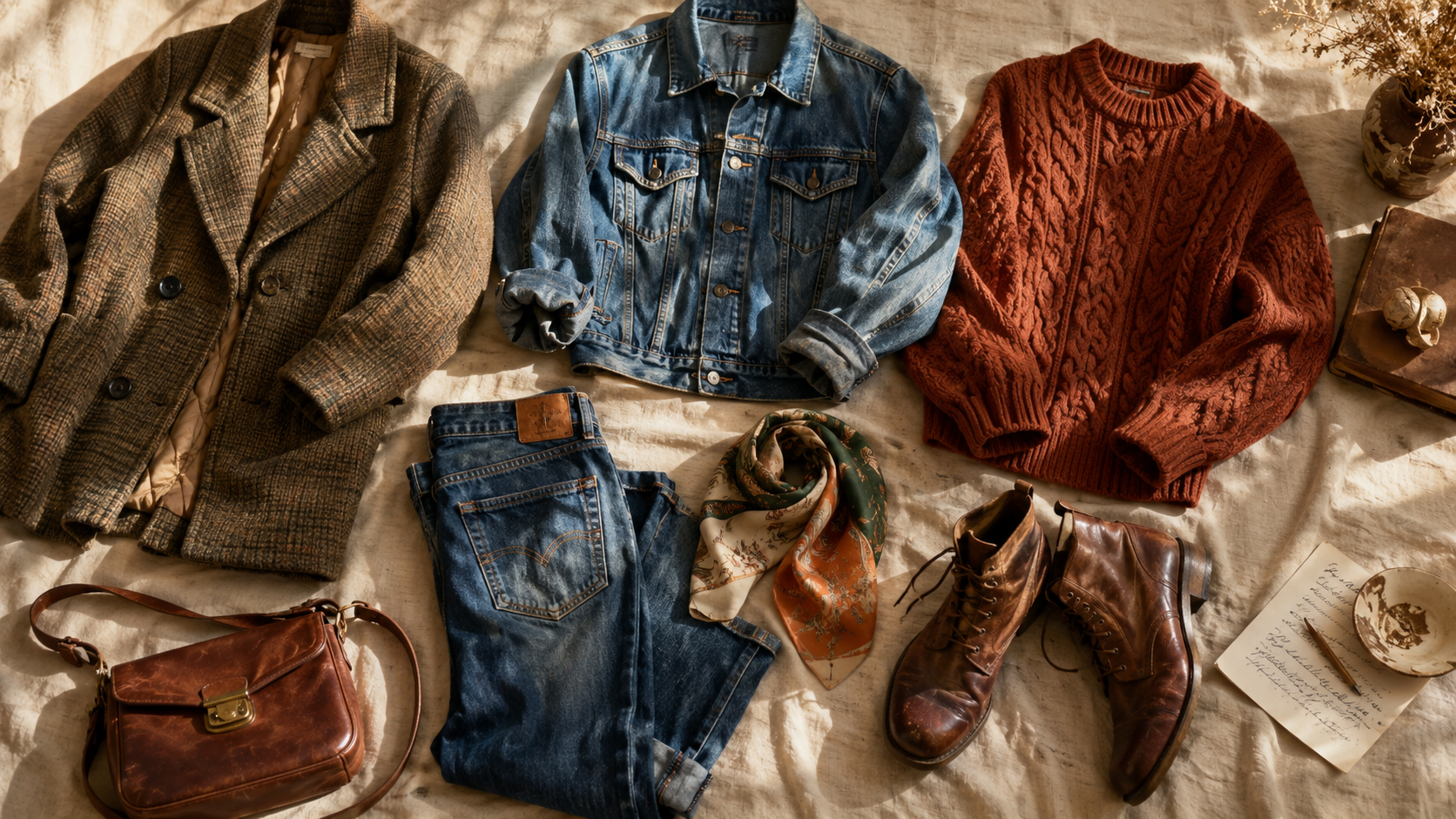
9 pieces bought (a denim jacket, three sweaters, two pairs of jeans, a dress, a scarf, a pair of boots)
-
$147 spent, versus an estimated $410 if bought new
-
Estimated savings: $263
Step 4: Months 3–4 — The Numbers Start Adding Up
By this point, vintage-first wasn't a rule I had to think about anymore — it was just how I shopped. I also started branching into categories I hadn't planned on: a leather bag, a set of wool gloves, a blazer that ended up becoming a work-wardrobe staple.
Consistency got a lot easier once I stopped treating it as a one-time challenge and started treating it as a weekly errand. Since new stock rotates constantly, stopping by our Plateau location every week or two meant I was never stuck waiting for "the right piece" to show up online.
Four-month running total:
-
17 pieces bought
-
$289 spent, versus an estimated $780 if bought new
-
Estimated savings: $491
Step 5: Months 5–6 — The Final Tally
The last stretch was less about restraint and more about refinement — I got pickier, which honestly made the "finds" feel even better. The best one: a mid-century wool coat, barely worn, for less than a tenth of what a comparable new coat would cost. It's the kind of piece that makes the whole exercise click — you're not settling for secondhand, you're upgrading into something with actual character.
Six-month final total:
-
26 pieces bought
-
$438 spent, versus an estimated $1,215 if bought new
-
Total estimated savings: $777
-
26 pieces diverted from landfill or fast-fashion production entirely
Calculate Your Own Impact
You don't need six months of receipts to make this meaningful — the method scales down easily:
-
Log what you spend and what the retail-new equivalent would cost. Subtract for your dollar savings.
-
Count your pieces. Each one is a garment that didn't need new raw materials, dyes, water, or transport.
-
Use a free per-garment water/CO2 estimate (widely available online) to translate your item count into a rough environmental figure — it won't be exact, but it's a real, honest ballpark.
Keeping the Habit Going
Six months in, here's what actually made the habit stick, long after the "challenge" framing wore off:
-
Make it a weekly stop, not a special occasion. New arrivals mean there's always a reason to check back.
-
Keep one flexible rule, not a rigid list — mine ("new only if truly necessary") left enough room that I never felt deprived.
-
Learn what to look for. A little bit of vintage know-how goes a long way — learn how to spot quality vintage pieces so you're buying pieces built to last another few decades, not just another few months.
The Bottom Line
Six months, 26 pieces, $777 saved, and a closet full of things I actually reach for — that's what buying vintage clothing added up to, in real numbers. It turns out sustainable fashion isn't an abstract feel-good idea; it's something you can track, measure, and honestly, have a lot of fun doing.
If you're ready to start your own version of this challenge, this week's new arrivals are waiting at our Plateau and Lachine locations — come see what your first find could be.