Cart
0
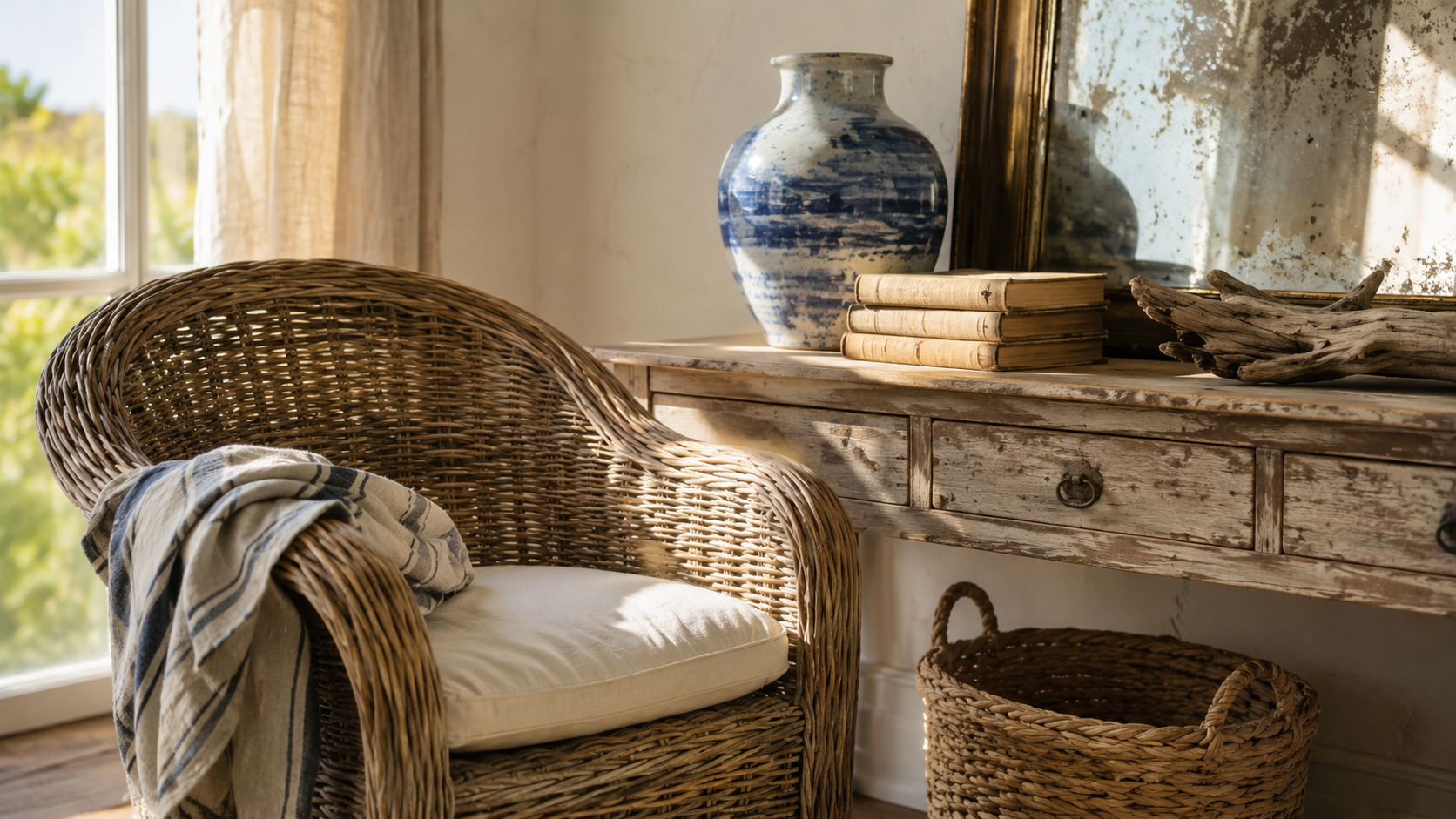
You don't need an ocean view to catch that sun-bleached, breezy feeling — and you definitely don't need a Muskoka-chair budget. Some of the best vintage coastal decor we've ever seen came out of a Plateau walk-up, styled entirely with thrifted rattan, chipped ceramics, and one very lucky brass find from our Lachine floor. Coastal style, done right, isn't about anchors on every wall. It's about weathered materials, honest textures, and a palette that feels like it's been sitting in the sun for decades — because, often, it has.
That's where vintage comes in. New "coastal" furniture fakes the look with distressed paint and factory rattan. Vintage pieces come by that texture honestly, which makes them the most sustainable, most affordable, and frankly most authentic way to build the look. This guide walks you through it step by step — palette, materials, styling — so you can start hunting with a plan instead of just hoping for the best.
Difficulty: Beginner-friendly.
Time: Can be done in one weekend or built gradually as pieces find you — either works.
Step 1: Choose Your Coastal Palette First
Before you buy a single thing, settle on a palette. It's the difference between a room that reads "coastal" and one that reads "nautical theme party." Stick to a tight range: driftwood tan, chalky white, soft seafoam or dusty blue, and a warm sandy neutral to ground it all.
The easiest way to land on your palette without overthinking it? Let one vintage piece choose it for you. A blue-and-white ceramic vase, a faded striped cushion, a piece of sea glass — pull your colors from there and build outward. It keeps the whole space feeling curated instead of matchy.
Step 2: Hunt for Weathered, Natural Materials
This is the heart of good coastal vintage home decor — and it's where thrifting genuinely outperforms buying new. Look for rattan, cane, wicker, sun-bleached wood, hand-blown or textured glass, stoneware ceramics, and raw linen. These materials age beautifully, and every scuff or sun-fade is doing your styling work for you.
Skip anything trying too hard to look "beachy." A real 1970s rattan chair with a little wobble in the leg has more character — and a smaller footprint — than a brand-new one built to imitate it. Our furniture floor turns over weekly, so cane and rattan pieces move fast; if you spot one, it's worth grabbing.
Step 3: Layer in Nautical Accents — Without Going Kitsch
Here's the line most coastal decor crosses: too many nautical accents and the room stops feeling like a home and starts feeling like a seafood restaurant. Good rule of thumb — two or three nautical touches per room, max.
Look for brass fixtures with real patina, vintage glass fishing floats, coiled rope in a bowl, ceramic shell dishes, or a foxed, weathered mirror. One well-chosen piece with real age on it will always beat a cluster of new "vintage-style" ones.
Step 4: Style a Coastal Vignette
Pick one surface — a console, a mantel, a shelf — and build a small scene instead of scattering pieces around the room. The formula that works almost every time: odd numbers, varying heights, and a little negative space so nothing feels crowded.
Try this combination as a starting point: a ceramic vase, a short stack of vintage books, a piece of driftwood, and a small mirror angled to catch the light. Swap pieces in and out as new finds turn up — that's half the fun of building a collection this way.
Step 5: Mix in Vintage Textiles
Textiles are the fastest, cheapest way to shift a room's mood — and coastal style leans on them hard. Look for linen in soft neutrals, faded striped ticking fabric, seagrass or rattan baskets, and woven placemats or table runners.
Even one thrifted linen cushion cover can do more for the coastal feel than a new throw pillow ever will, simply because it already has that lived-in softness new fabric takes years to earn.
Step 6: Anchor the Room with One Statement Piece
Once your smaller pieces are in place, look for one larger anchor: a rattan armchair, a cane headboard, a weathered wood console, or a vintage steamer trunk repurposed as a coffee table. One strong statement piece will always do more for a room than a dozen small accessories fighting for attention.
Finishing Touches: Bring the Outside In
Round things out with dried florals, a bowl of shells (thrifted or collected), driftwood pieces leaned in a corner, and a woven basket or two for plants. These are the details that keep a coastal room feeling alive rather than staged — and they're easy to rotate seasonally as your eye (and your collection) evolves.
FAQ
Is coastal decor the same as nautical decor? Not quite. Nautical leans into maritime symbols — anchors, ropes, ship wheels. Coastal is broader and softer: it's about materials, texture, and a relaxed, sun-worn palette, with nautical touches used sparingly as accents rather than the whole theme.
Can I get this look on a small budget? Yes — arguably it's easier on a budget with vintage than new. A few well-chosen thrifted pieces (a vase, a linen cushion, one rattan accent) can shift a room's whole feeling for a fraction of what "coastal collection" furniture costs retail.
Where can I find vintage rattan furniture in Montreal? Both EcoDepot locations — Lachine and Plateau — restock weekly with furniture, decor, and textiles, so rattan and cane pieces show up regularly. Since we can't hold specific inventory, the best approach is checking in often or following us for new-arrival updates.
Bring the Coast Home
Building a coastal look with vintage pieces isn't about buying a "collection" all at once — it's palette first, then materials, then accents, built one honest find at a time. That's what makes it feel real instead of staged, and it's a lot easier on both your wallet and the planet than starting from scratch with new furniture.
Ready to start the hunt? Stop by our Lachine or Plateau locations this week — with new arrivals landing constantly, you never know when the next rattan chair or sea-glass vase is waiting for you.