Chariot
0
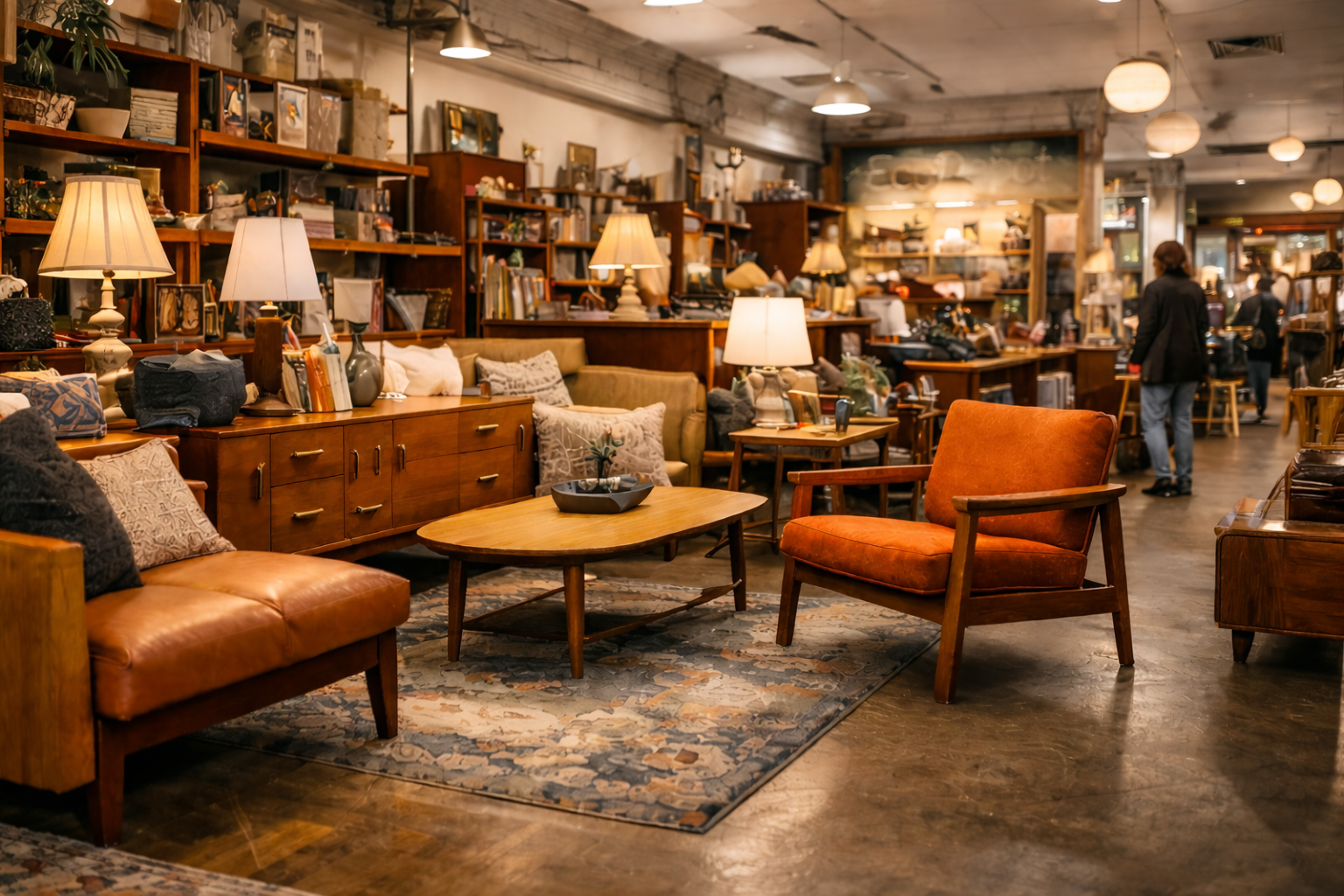
You're browsing a Plateau walk-up, and there it is—a 1960s teak credenza with brass pulls, its warm wood grain catching the afternoon light. Similar pieces retail for $2,000 at design boutiques. Your price? $285. This isn't fantasy. It's the reality of choosing vintage over fast furniture, and it's happening in Montreal thrift stores every week.
The appeal of cheap furniture from big-box retailers is undeniable. Walk in, walk out with a bookshelf for $79, a dresser for $199. But those price tags hide costs that surface later—in landfills overflowing with particle board, in forests cleared for throwaway pieces, in your wallet when that dresser wobbles after six months. Fast furniture promises convenience but delivers a cycle of replacement, waste, and missed opportunities for something better.
Vintage furniture flips this equation entirely. Every piece offers triple value: it's a sustainability win that keeps quality goods in circulation, a budget-friendly choice that often costs less than new, and a one-of-a-kind find with character no assembly line can replicate. From mid-century modern credenzas perfect for Mile End lofts to solid oak dressers built for Verdun character homes, vintage delivers what fast furniture never can—furniture with a past and a future.
But what exactly are we paying for when we choose fast furniture? And why does vintage make more sense for Montreal homes, both for your space and your conscience?
What Is Fast Furniture?
Fast furniture is the home decor equivalent of fast fashion—cheaply made, trend-driven pieces designed for short-term use and quick replacement. Walk into any big-box furniture store, and you're surrounded by it: bookshelves that arrive flat-packed, dressers assembled with an Allen key, coffee tables made from materials that couldn't exist in nature.
The construction tells the story. Particle board and medium-density fiberboard (MDF) replace solid wood. Laminate veneers mimic real wood grain. Metal hardware gets swapped for plastic. Joints that should be dovetailed are instead stapled or glued. The engineering is impressive in its efficiency—lightweight materials keep shipping costs down, simple assembly means no skilled labor required, trendy designs cycle through quickly to match whatever's popular on Instagram this month.
This furniture isn't built to last, and that's intentional. The average lifespan of fast furniture? Five years, maybe seven if you're gentle and never move. Compare that to the vintage pieces circulating through Montreal's thrift stores—dressers from the 1960s, chairs from the 1970s, tables from the 1950s. These pieces have already survived 50-plus years and show no signs of stopping.
The business model depends on replacement. When your $400 particle-board dresser's drawer tracks fail after three years, repair isn't an option. The materials won't hold new hardware. The structure can't be reinforced. You're back at the store, buying another $400 dresser, perpetuating a cycle that benefits manufacturers but costs you money and the planet resources.
For Montreal's bilingual, style-conscious market, fast furniture presents a particular appeal. Students furnishing McGill dorm rooms, young professionals in transitional Plateau apartments, families on tight budgets—the low upfront costs seem to make sense. A $79 bookshelf feels affordable when you're moving into your first place. What's harder to see is that same bookshelf sagging under textbook weight within a year, destined for a landfill by graduation.
Consider the math: A $400 particle-board dresser lasting five years costs you $80 per year. A $250 solid wood vintage dresser from EcoDepot lasting 50 years? That's $5 per year. The vintage piece is actually cheaper, even at a higher price point, because quality compounds over time while disposability multiplies costs.
The materials matter beyond just longevity. Particle board is engineered wood—wood particles glued together with resins and pressed into sheets. It's weak, prone to water damage, and nearly impossible to repair. When a screw strips out of particle board, that hole is permanent. Solid wood, by contrast, holds hardware firmly, can be sanded and refinished, withstands moisture better, and actually improves with age as the wood develops patina.
Fast furniture thrives on immediate availability and trend-chasing. Want a bookshelf today? Drive to the store, buy it, bring it home. Want the latest "farmhouse modern" or "Scandinavian minimalist" look? Fast furniture adapts quickly, churning out pieces that approximate expensive styles at bargain prices. This convenience and trendiness mask the deeper costs—environmental, financial, and aesthetic—that vintage furniture avoids entirely.
The Hidden Environmental Costs
Beyond those tempting price tags lurks an environmental toll most shoppers never see. Fast furniture's impact stretches from forest to landfill, touching ecosystems, air quality, and climate systems along the way.
Deforestation and Resource Depletion
The furniture industry drives 70% of global demand for tropical wood. Every year, furniture production contributes to logging over 15 million hectares of forest—an area roughly the size of England and Wales combined. Those $200 bookshelves and $500 entertainment centers are directly connected to vanishing rainforests, disrupted habitats, and species pushed toward extinction.
Deforestation ranks as the second-leading cause of climate change after fossil fuels. Why? Forests act as carbon sinks, absorbing about 2.5 billion tons of CO2 annually—roughly one-third of all fossil fuel emissions. When furniture manufacturers clear forests for cheap timber, they eliminate these natural carbon absorbers while simultaneously releasing stored carbon back into the atmosphere. The impact doubles: less absorption capacity, more emissions.
Many fast furniture manufacturers favor lightweight materials like particle board partly to reduce shipping costs, but producing these engineered woods demands intensive energy. The resins binding wood particles together are petroleum-based. The pressing and curing processes require heat. The entire production chain depends on extractive industries—logging, petroleum, chemical manufacturing—that deplete finite resources while generating waste.
Montreal buyers might assume their furniture comes from sustainable sources, but supply chains obscure origins. That "wood-look" dresser at a chain store could contain timber from clear-cut tropical forests, processed in factories powered by coal, finished with chemical treatments that pollute water systems. The true source remains hidden behind packaging and marketing.
Mountains of Waste
Americans discard more than 12 million tons of furniture annually. Canadian statistics mirror this trend, with furniture waste growing 450% since 1960. Montreal's waste management systems struggle with this volume, as approximately 80% of discarded furniture ends up in landfills rather than being recycled or repurposed.
That $599 bookshelf you bought for your Plateau apartment? Statistics suggest it'll occupy landfill space within five years, joining millions of similar pieces. Fast furniture's short lifespan creates a disposal crisis. Unlike biodegradable materials, particle board and MDF don't break down cleanly. They sit in landfills, slowly releasing methane—a greenhouse gas significantly more potent than CO2—as organic components decompose.
The waste problem compounds because fast furniture isn't designed for repair. When a drawer track breaks or a hinge fails, replacement parts don't exist. The engineering that makes assembly easy makes disassembly for repair nearly impossible. Glued joints can't be separated without destroying the piece. Stapled connections can't be reinforced. The entire item becomes trash over a single point of failure.
Consider a scenario familiar to Montreal movers: You're relocating from a third-floor Plateau walk-up to a Verdun duplex. That particle-board dresser didn't survive the stairs. The material crumbled where movers gripped it. The joints separated under stress. Now you're shopping for a new dresser and scheduling a pickup to dump the old one. This cycle repeats across the city, thousands of times yearly, filling dumpsters with furniture that should have decades of use remaining.
Meanwhile, the 1970s credenza at EcoDepot has survived multiple owners, numerous moves, and 50 years of daily use. It could serve your home for another 50 years before even approaching end-of-life. This is the difference between building for longevity versus engineering for obsolescence.
Toxic Chemicals and Indoor Air Quality
Walk into a room furnished entirely with new fast furniture, and you'll notice a smell—that "new furniture" scent many people oddly enjoy. What you're actually smelling is off-gassing: the release of volatile organic compounds (VOCs), formaldehyde, and other chemicals used in manufacturing.
Formaldehyde, commonly found in the adhesives binding particle board and MDF, causes watery eyes, throat irritation, nausea, and breathing difficulties. Long-term exposure links to more serious health concerns. The EPA has identified formaldehyde as a known human carcinogen. Medium-density fiberboard—the material in most fast furniture—contains higher resin-to-wood ratios than other pressed wood products, making it one of the highest formaldehyde-emitting materials in your home.
The off-gassing process intensifies during the first year after purchase, accelerated by heat and humidity—exactly the conditions in many Montreal apartments during summer months. You've essentially brought a chemical emission source into your living space, slowly releasing compounds into air your family breathes daily.
Flame retardants, surface finishes, adhesives, dyes—each adds to the chemical load. These substances accumulate in your body over time. Since the average person receives 72% of their chemical exposure at home, the furniture surrounding you significantly impacts your health. Children playing on the floor near that new particle-board bookshelf? They're receiving concentrated exposure during crucial developmental periods.
Vintage furniture, by contrast, completed its off-gassing decades ago. Those harmful compounds already dissipated years before the piece arrived at EcoDepot. What remains is stable, aged wood and time-tested finishes. You're furnishing your home with pieces that have already proven they won't harm indoor air quality.
This environmental cost—deforestation, waste, and chemical pollution—represents fast furniture's true price. That $400 dresser costs far more than its price tag suggests when you account for forests cleared, landfills filled, and air quality degraded. Vintage furniture sidesteps these costs entirely, offering a path that protects both planet and home.
Why Vintage Furniture Is Better: Beyond Sustainability
Sustainability matters, but let's be honest: you're also furnishing a home you want to love. Vintage furniture delivers environmental benefits while exceeding fast furniture in craftsmanship, character, and actual value for money. This isn't about sacrifice—it's about getting more for less.
Superior Craftsmanship and Materials
A Danish modern credenza from the 1960s features solid teak and hand-cut dovetail joints. Compare that to the stapled particle board in most $800 "mid-century inspired" pieces from contemporary retailers. The difference isn't subtle—it's fundamental to how furniture functions and lasts.
Solid wood construction means real oak, maple, teak, or walnut throughout the piece. Not veneer over particle board. Not laminate printed to look like wood. Actual lumber, cut, shaped, and joined using techniques refined over centuries. These materials respond to humidity changes by expanding and contracting slightly but maintaining structural integrity. Particle board, by contrast, swells permanently when exposed to moisture, warping drawers and destroying joints.
Real joinery techniques distinguish vintage craftsmanship. Dovetail joints—those interlocking "fingers" visible on quality drawer corners—create connections stronger than the wood itself. Mortise-and-tenon joints lock table legs to aprons without relying on screws or glue. These joints survive decades of use because they distribute stress across larger surface areas and use wood's natural strength. Compare this to staples shot through particle board, or cam locks connecting pieces of MDF, and you understand why vintage furniture survives while fast furniture fails.
Hardware quality tells stories too. Solid brass drawer pulls age beautifully, developing rich patina. Metal hinges from the 1950s still swing smoothly because they were engineered to last. Door catches actually catch. Drawer glides—even simple wooden runners on vintage pieces—outlast the plastic-wheeled tracks in modern dressers that inevitably crack or jam.
Finishes on vintage furniture were designed to protect and enhance wood, not just mimic it. Oil finishes penetrate wood, protecting from within while allowing natural beauty to show. Shellac and lacquer finishes from mid-century pieces can be refreshed and repaired. These finishes improve with age, developing warmth and depth. Laminate finishes on fast furniture chip, peel, and can't be restored. Once damaged, the piece looks permanently shabby.
This craftsmanship wasn't reserved for luxury items. Even modest furniture from the 1960s and 70s was built substantially better than today's mid-range offerings. A basic dresser from 1965 features solid wood drawers with dovetail joints, metal glides, and real wood veneer over solid wood cores. A basic dresser from 2025 features particle board drawers with stapled corners, plastic glides, and printed laminate surfaces. Both might cost around $300-400, but only one will still be functional in 2050.
Unique Character and Design Value
Every vintage piece carries history you can see and feel. That teak credenza at EcoDepot didn't come off an assembly line yesterday—it was handcrafted in Denmark in 1967, lived in someone's home for decades, developed scratches and patina that tell its story, and now waits to continue that story in your Mile End loft. This narrative depth is impossible to manufacture.
Authentic mid-century modern, Art Deco, or vintage styles aren't reproductions approximating a look. They're the real thing—designed during the eras that created these movements, built by craftspeople who understood the aesthetic deeply, using materials and techniques that defined those periods. A genuine Eames-era lounge chair versus a modern knock-off? The difference is immediately apparent in proportion, materials, and how the piece occupies space.
Montreal's diverse neighborhoods benefit particularly from vintage character. Those Plateau walk-ups with original details? They cry out for furniture with similar authenticity. Mile End lofts with exposed brick and wide windows? A mid-century modern credenza complements that industrial aesthetic perfectly. Verdun apartments in character buildings deserve furniture that respects that heritage. Fast furniture's generic styling clashes with these spaces, while vintage pieces feel like they belong.
The conversation starter factor matters more than it might seem. Guests notice the difference between mass-produced and unique. "Where did you get that chair?" becomes an opening to share stories about treasure hunting at EcoDepot, about the piece's history, about your aesthetic choices. Fast furniture prompts no such conversations because everyone recognizes it from the same stores.
Design eras that produced exceptional furniture—Scandinavian modernism of the 1950s-60s, American mid-century, British Arts and Crafts, French Art Deco—created pieces impossible to replicate today. Why? The economics have changed. Furniture makers then could spend time on details that contemporary manufacturers can't justify. Materials then were abundant that are now scarce or protected. Design philosophies then prioritized longevity over planned obsolescence.
These pieces have their own histoire—stories you can't buy at a chain store. That credenza held someone's records during the Summer of Love. That dining table hosted family dinners for three generations. That desk supported a novelist writing their first book. This history adds dimension to your space that no amount of trendy styling can match.
Better Value for Money
Here's where the math gets interesting. Vintage furniture often costs less upfront than fast furniture, lasts exponentially longer, and retains resale value. Let's break this down with real numbers.
A solid wood mid-century dresser at EcoDepot: $250. Expected lifespan with basic care: 50+ years (it's already proven it can last—it's 60 years old and still solid). Cost per year: $5.
A particle-board dresser from a big-box store: $500. Expected lifespan: 5-7 years. Cost per year: $71-100.
The vintage piece is genuinely cheaper, even though you might pay more initially. But often you don't even pay more initially. Browse EcoDepot's Lachine location, and you'll find solid wood dressers for $200-300, dining tables for $300-500, chairs for $40-80. These prices compete directly with fast furniture while offering dramatically superior quality.
The cost-per-year analysis becomes even more favorable when you factor in repairs. Vintage furniture can be repaired. A loose joint can be reglued. Drawer glides can be replaced. Finishes can be refreshed. These repairs cost far less than replacement and extend the piece's life indefinitely. Fast furniture, when it breaks, becomes trash. No repair shop will fix particle board because the repair costs more than replacement, and the materials can't hold repairs anyway.
Resale value tells another story. Quality vintage furniture holds value. That $250 dresser you buy today? You could likely sell it for $200-250 in five years because solid wood furniture doesn't depreciate like disposable goods. That $500 particle-board dresser? It's worth maybe $50 on Facebook Marketplace after two years—if anyone wants it. Most people can't even give away used fast furniture because buyers know it's near end-of-life.
For Montreal's budget-conscious shoppers—students, young families, anyone watching expenses—this value proposition matters enormously. Your style doesn't have to cost the earth, literally or financially. That Scandinavian modern aesthetic you love from expensive boutiques? You can achieve it with authentic vintage pieces for a fraction of the cost. The mid-century credenza that would cost $2,000 new sits at EcoDepot for $285. The teak dining table listed at $3,500 in design stores? Find its cousin for $450.
Accessibility matters. EcoDepot's two Montreal locations—Lachine and Plateau—serve different communities but share the same mission: making quality vintage furniture available to everyone, regardless of budget. Weekly arrivals mean fresh inventory constantly, keeping prices competitive and selection diverse. From everyday essentials like solid wood bookcases ($80-150) to designer dreams like authentic mid-century pieces ($300-800), the range accommodates real Montreal budgets.
The value extends beyond purchase price to ownership experience. Living with quality furniture that functions smoothly, looks beautiful, and improves your space daily creates satisfaction fast furniture can't match. Drawers that glide rather than stick. Surfaces that develop character rather than chip. Proportions that feel right because designers spent time getting them right, not just approximating trendy styles.
The Real Numbers: Fast Furniture vs. Vintage
Abstract environmental concepts become concrete when you examine actual data. The numbers reveal why choosing vintage furniture represents one of the most impactful individual sustainability actions available.
The furniture industry contributes approximately 2% of global CO2 emissions—matching the entire aviation industry's output. Think about that comparison: all the world's planes generate the same carbon footprint as furniture manufacturing. Much of this impact comes from energy-intensive production processes, global shipping networks, and rapid disposal cycles that force constant new manufacturing.
Reusing furniture eliminates 85-97% of emissions compared to buying new. That's not a small reduction—it's nearly complete elimination. When you choose a vintage dresser at EcoDepot instead of a new particle-board equivalent, you avoid the carbon emissions from harvesting raw materials, manufacturing components, assembling the piece, packaging it, and shipping it across oceans. All that embedded carbon? Already spent decades ago. The piece sitting in front of you has no additional manufacturing footprint.
Resource savings compound beyond just carbon. Every vintage purchase prevents extraction of new raw materials. No trees cut. No petroleum processed into resins and plastics. No metals mined and smelted. No water consumed in manufacturing. The resources already invested in creating the piece continue generating value instead of being wasted.
Waste diversion matters particularly in Montreal's context. With 12 million tons of furniture waste generated annually in North America, every piece kept from landfills counts. Montreal's waste management infrastructure faces pressure from growing populations and limited landfill space. When you buy vintage, you're pulling from the existing stock of quality furniture rather than adding to the disposal stream.
The local economic impact deserves attention too. Shopping at EcoDepot keeps money circulating in Montreal neighborhoods. Two locations—Lachine at 187 Rue Richer and Plateau at 2117 Rue Rachel Est—serve their communities directly, creating jobs, supporting local suppliers, and contributing to neighborhood vitality. This contrasts with fast furniture chains where profits leave the province and manufacturing happens overseas.
Supporting Montreal's circular economy creates resilience. Thrift stores, vintage shops, and consignment outlets form a network that captures value otherwise lost. Quality furniture that might have been discarded instead finds new homes. Sellers gain income from pieces they no longer need. Buyers access quality goods at accessible prices. The community benefits from reduced waste and sustained economic activity.
How to Shop for Vintage Furniture in Montreal
Ready to dive into vintage hunting? Montreal offers rich opportunities, but knowing what to look for and where to find it transforms browsing into strategic discovery.
What to Look For
Quality vintage furniture reveals itself through specific indicators. Train your eye to spot these details, and you'll avoid the particle-board pieces that occasionally sneak into vintage inventories while finding true gems.
Solid wood identification starts with weight and edges. Solid wood furniture feels substantially heavier than particle board equivalents. Examine edges and corners—you should see wood grain running through the entire thickness, not a thin veneer over compressed materials. Look at the back and bottom of pieces too. Quality furniture uses solid wood even where it's hidden. Particle board or plywood backs indicate cost-cutting.
Joint quality separates well-built from cheaply made. Open drawers and look at corners. Dovetail joints—those interlocking fingers—indicate quality construction. They should fit tightly with no gaps. French dovetails (curved rather than straight) suggest even higher craftsmanship. Screws are acceptable, but they should be substantial, not tiny finishing screws. Staples? That's a red flag suggesting the piece won't survive long-term use.
Drawer glide testing provides immediate functional assessment. Pull drawers fully out and push them back in. They should move smoothly without catching or requiring force. Wooden glides are fine—they've survived decades, so they'll survive more. Metal glides are excellent. Plastic glides that crack easily suggest newer, lower-quality construction. Drawers should also be solid when extended. If they wobble or feel like they might fall, joints are failing.
Structural integrity check requires hands-on assessment. Gently rock the piece. Some movement is normal, but it should feel solid overall. Examine legs where they join the body—this is where stress concentrates. Look for cracks, splits, or repairs. Sit on chairs and apply your full weight. They should feel stable and support you confidently. Tables should stand level without wobbling.
Patina versus damage assessment takes practice. Patina—the natural aging of wood and finishes—adds character and proves authenticity. Surfaces with gentle wear, slightly darkened areas, minor scratches that tell stories? That's desirable patina. Damage looks different: deep gouges, water stains that warp wood, structural cracks, missing pieces, burns. Some damage can be repaired or lived with, but know what you're getting.
Designer and maker marks occasionally appear on vintage pieces. Check underneath tables and chairs, inside drawers, on backs of pieces. Labels, stamps, or branded hardware from Herman Miller, Knoll, Eames, Danish manufacturers like Skovby or Dyrlund, or other quality makers indicate valuable finds. Even unmarked pieces can be excellent, but marks help establish provenance and value.
You don't need expert knowledge to shop successfully. Start by checking these basics, and you'll quickly develop intuition for quality. Staff at places like EcoDepot can answer questions too—the treasure-hunt community welcomes newcomers rather than gatekeeping.
Where to Find Quality Vintage in Montreal
Montreal's vintage furniture scene offers options across price points and neighborhoods, but not all sources are created equal.
EcoDepot Montreal operates two locations serving different parts of the city with the same commitment to curated, quality second-hand and vintage finds.
The Lachine location (187 Rue Richer, Lachine, H8R 1R4) offers EcoDepot's largest selection across all categories. This is where you'll find the most extensive vintage furniture inventory, from mid-century credenzas to solid oak dining sets to unique statement pieces. The space allows for substantial inventory, meaning more options for treasure hunters. Weekly arrivals keep selection fresh—what you see one week might be completely different the next.
The Plateau location (2117 Rue Rachel Est, H2H 1R1) brings EcoDepot's curated approach to the neighborhood's walk-ups and character buildings. Perfectly positioned for locals who can walk or bike to browse, this location emphasizes pieces that work in smaller Montreal apartments while maintaining quality standards. It's become a neighborhood fixture, the kind of place where regular customers check in weekly to see new arrivals.
Both locations operate Monday-Wednesday 10am-6pm, Thursday-Friday 10am-8pm, and weekends 10am-6pm. Insider tip: Thursday evenings after work and Saturday mornings tend to be best for first crack at newly arrived pieces. Staff can tell you what just came in, and they're genuinely excited about the furniture—no hard sell, just enthusiasm for great finds.
What makes EcoDepot stand out is the curation. Not every donated piece makes it to the floor. Items are assessed for quality, condition, and appeal. This means you're browsing furniture that's already been vetted rather than sorting through everything hoping to find gems among junk. The inventory spans from everyday essentials (solid wood bookcases, functional dressers, practical dining chairs) to designer dreams (authentic mid-century pieces, unique vintage lighting, statement furniture). Prices reflect true value—affordable but fair, accessible to Montreal's diverse communities.
Beyond EcoDepot, Montreal offers additional vintage hunting grounds worth exploring. Renaissance operates multiple locations around Montreal, offering broad selection with proceeds supporting job training programs. Village des Valeurs provides treasure-hunting on a larger scale, though finding quality pieces requires more patience and sorting.
Mile End and Plateau vintage boutiques specialize in curated vintage furniture, often at higher price points but with carefully selected inventories. These shops serve clients seeking specific eras or styles and willing to pay for the curation.
Online marketplaces—Facebook Marketplace, Kijiji—connect buyers directly with sellers in the Montreal area. You'll find everything from amazing deals to overpriced junk. Success requires patience, quick responses (good pieces sell fast), and willingness to inspect items before purchase. Safety matters too—meet in public places, bring someone with you, and trust your instincts.
Estate sales occasionally offer exceptional opportunities for vintage furniture, particularly in neighborhoods like Outremont, NDG, and Westmount where older homes contain accumulated furniture from previous eras.
The key is developing a hunting routine. If you're serious about finding that perfect mid-century credenza or solid oak dining table, visit EcoDepot weekly, browse online listings daily, and check other sources regularly. Quality vintage furniture moves quickly in Montreal's active second-hand market. The treasure-hunt aspect means you never know when exactly the right piece will appear—but when it does, you need to act.
Styling Vintage in Your Montreal Home
Vintage furniture adapts beautifully to Montreal's eclectic residential architecture, from Plateau walk-ups to Mile End lofts to Verdun character homes. The key is mixing eras and styles thoughtfully rather than creating museum displays.
Mix vintage with modern for the eclectic aesthetic Montreal does so well. A mid-century credenza pairs perfectly with contemporary art and modern lighting. Vintage dining chairs around a simple modern table create visual interest. That 1970s teak desk works beautifully in a space with minimal Scandinavian accessories. The contrast between old and new adds depth and prevents spaces from feeling theme-park staged.
Small Montreal apartments benefit particularly from vintage furniture because older pieces were often designed for smaller spaces. Mid-century credenzas provide substantial storage in compact footprints. Vintage apartment-sized sofas fit perfectly in narrow living rooms. Corner cabinets maximize awkward spaces. Unlike contemporary furniture often designed for suburban homes, vintage pieces frequently suit urban apartment proportions.
Room-specific applications help you integrate vintage thoughtfully:
Living rooms: Vintage credenzas serve as media consoles while hiding clutter. Mid-century lounge chairs create reading nooks. Vintage coffee tables anchor seating areas with character.
Bedrooms: Solid wood dressers offer storage that lasts. Vintage nightstands add bedside functionality with style. Mid-century headboards provide architectural interest.
Dining rooms: Vintage dining tables host gatherings with stories to tell. Mix-and-match vintage chairs create casual, curated looks. Vintage sideboards provide serving and storage space.
Home offices: Vintage desks offer workspace with character and often superior craftsmanship to modern equivalents. Vintage bookcases display books while making organizational statements.
Quick styling tips maximize vintage's impact:
Let quality pieces stand out rather than crowding them. A beautiful mid-century credenza deserves space to breathe.
Play with height variations—vintage furniture comes in different proportions that create visual rhythm when combined.
Use vintage pieces as focal points with simpler contemporary items supporting them.
Don't worry about matching wood tones perfectly. Real homes accumulate furniture over time, and that variety adds authenticity.
Consider scale carefully. Oversized vintage pieces can overwhelm small Montreal apartments, while pieces too small get lost.
Neighborhood-specific considerations:
Plateau walk-ups with original details benefit from vintage pieces that respect that heritage. Mid-century modern complements exposed brick. Art Deco pieces echo the buildings' era.
Mile End lofts with industrial bones pair beautifully with both mid-century modern (wood warmth against concrete and brick) and vintage industrial pieces.
Verdun apartments in character buildings deserve furniture with similar gravitas. Solid wood pieces from the 1940s-60s feel appropriate to the architecture.
NDG character homes can accommodate larger vintage pieces—dining sets, substantial credenzas, hefty bookcases that smaller apartments can't handle.
The beauty of vintage furniture is its flexibility. These pieces have survived decades in various settings, proving their adaptability. Trust your instincts, prioritize what you love, and recognize that authentic vintage brings character no amount of new furniture can manufacture.
Conclusion
Fast furniture's true costs extend far beyond checkout prices. Every year, 12 million tons of particle-board dressers, MDF bookshelves, and laminate entertainment centers fill North American landfills after serving brief, unsatisfying lifespans. Behind each piece lies deforestation, carbon emissions, toxic chemical exposure, and the extraction of resources that will never be recovered. That $400 dresser that wobbles after six months represents a false economy—cheap today, expensive tomorrow, costly to the planet always.
Vintage furniture inverts this equation entirely. Every solid wood piece delivers triple value: genuine sustainability that keeps quality goods circulating, authentic affordability that costs less per year of use, and one-of-a-kind character that transforms houses into homes. A 1960s teak credenza doesn't just store your belongings—it tells stories, adds warmth, and proves that quality compounds over time while disposability multiplies costs.
The treasure hunt itself becomes part of the value. Walking into EcoDepot's Lachine or Plateau location, you never know exactly what you'll find. That mid-century masterpiece might be waiting on the shelf this week. That solid oak dining table your great-grandchildren could inherit might arrive in tomorrow's delivery. This anticipation, this possibility, adds excitement that big-box furniture stores—with their predictable, identical inventories—can never match.
Montreal's neighborhoods deserve better than particle board and planned obsolescence. Those Plateau walk-ups, Mile End lofts, and Verdun character homes cry out for furniture with equal character, craftsmanship that respects their heritage, and authenticity that complements their bones. Vintage furniture delivers this while protecting forests, reducing waste, and keeping money in local communities.
Your choices matter. Every vintage purchase prevents resource extraction, diverts waste from landfills, and extends the value already invested in quality craftsmanship. These aren't abstract environmental benefits—they're concrete impacts multiplied across thousands of individual decisions.
Ready to discover your next treasure? Visit EcoDepot's Lachine location (187 Rue Richer) or Plateau shop (2117 Rue Rachel Est) this week. With new arrivals every week, you never know what Danish modern credenza, solid oak dresser, or authentic mid-century chair is waiting to begin its next chapter. From everyday essentials to designer dreams, every item deserves a second act—and your home deserves furniture with a past and a future.
That vintage chair you've been eyeing? It's not just furniture—it's a conversation starter, a sustainability win, and a fraction of what you'd pay for a knockoff. Plus, someone actually crafted it with their hands decades ago, intending it to last. Come see what's waiting for you.