Cart
0
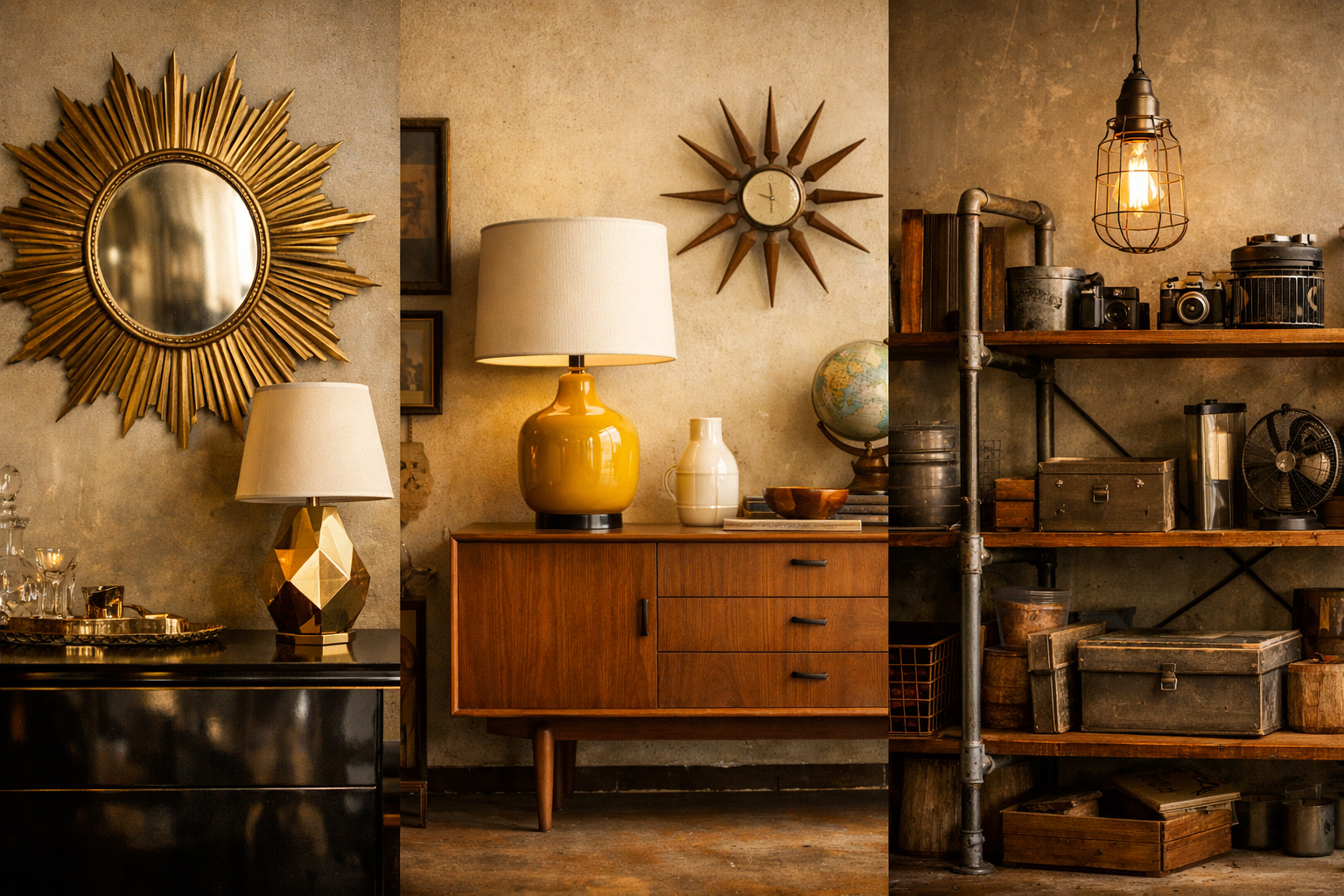
You're browsing a thrift store when you spot it — a low wooden credenza with tapered legs, a sunburst mirror with brass detailing, a raw metal shelf with a pipe frame. Something stirs. You know you love it. But what is it, exactly? And will it actually work in your apartment?
Art Deco, Mid-Century Modern, and Industrial are three of the most beloved — and most frequently confused — design styles in the vintage and thrift world. They dominate the shelves at EcoDepot, show up at every Montreal flea market, and anchor some of the most stunning apartments in the Plateau, Mile End, and Verdun. But without knowing how to tell them apart, you might walk right past a gem, or bring home something that clashes with everything else you own.
This guide will change that. By the end, you'll be able to spot each style instantly — on the shop floor, at a garage sale, or scrolling through listings online. No design degree required. Just a good eye, which we're about to give you.
Why Knowing Your Design Styles Is a Superpower for Thrift Shopping
Thrift shopping rewards the prepared. When you can walk into EcoDepot and immediately recognize a mid-century teak credenza versus an Art Deco lacquered cabinet, you make faster decisions, avoid costly mistakes, and spot value that other shoppers miss. More importantly, you stop second-guessing yourself.
It also makes your home more cohesive. Montreal apartments have personality built in — the high ceilings and crown moulding of a Plateau walk-up, the raw brick of a Mile End loft, the open layout of a converted Verdun flat. Knowing which styles work with what you already have means every new find adds to the story rather than muddying it.
Ready? Let's sharpen that eye.
Step 1 — How to Recognize Art Deco
The Era & Spirit
Art Deco arrived in the aftermath of World War I, peaked through the opulent Roaring Twenties and early 1930s, and never fully disappeared. Born in Paris and spread across the Atlantic, it was a movement drunk on the future — on machines, on geometry, on the idea that modern life could be both efficient and spectacular.
Think Radio City Music Hall. Think the Chrysler Building. Think jazz clubs with mirrored walls and gilded everything. Art Deco was the design movement that wanted to impress you, full stop. "The goal was modernity, but modernity with polish and spectacle," as one antique appraiser puts it. Every element was intentional, theatrical, and a little bit extra.
What to Look For — The Checklist
When you're scanning a thrift floor for Art Deco pieces, train your eye on these:
• Motifs & patterns: Sunbursts, zigzags, chevrons, stepped silhouettes, fan shapes — repeated, symmetrical, and bold. These aren't subtle accents; they're the whole point.
• Materials: Metallic finishes — gold, chrome, bronze. Lacquered wood. Mirrored surfaces. Exotic veneers like ebony or zebra wood. Everything has a sheen.
• Colours: Rich jewel tones — deep blue, emerald, burgundy — set against black and metallic accents. High contrast, never shy.
• Furniture form: Low-profile and geometric, but ornate. A cabinet with stepped sides. A vanity with a sunburst mirror. Decorative details that would feel excessive in any other era — but here, they're the style.
• Lighting: Geometric chandeliers. Frosted glass shades. Floor lamps with sculptural metal bases. Glamorous silhouettes that look like they belong on a stage set.
Quick Test
Does it feel like it belongs in a 1920s ballroom? Symmetrical, bold, a little theatrical? Does it have a sunburst or chevron anywhere on it? That's Art Deco. Pick it up.
Step 2 — How to Recognize Mid-Century Modern
The Era & Spirit
If Art Deco was the Roaring Twenties showing off, Mid-Century Modern was the postwar world taking a deep breath. From the late 1940s through the 1960s, designers like Charles and Ray Eames, Arne Jacobsen, and Eero Saarinen asked a different question: what if furniture could be beautiful and actually work for how people live?
"Form follows function" was the mantra. Factories, not specialty workshops, were producing furniture now — which meant designs had to be reproducible, practical, and accessible. The result was something remarkable: pieces that are elegant precisely because they don't try too hard.
What to Look For — The Checklist
Mid-Century Modern is probably the most coveted style at any thrift store — and with good reason. Here's how to recognize it:
• Lines & silhouettes: Clean and sleek, with tapered legs being the single biggest tell. If a sofa, credenza, chair, or table has those iconic angled wooden legs, you're in the right era.
• Materials: Teak, walnut, and rosewood are the holy trinity. Also: bent plywood, moulded fibreglass, laminate, and early plastics. These were the innovative materials of the moment.
• Colours: Warm neutrals anchoring the space, with pops of mustard yellow, avocado green, burnt orange, or a saturated primary red or blue as accent. Think: a teak sideboard with an orange ceramic lamp on top.
• Furniture form: Functional first, beautiful second — but often both at once. No excess ornamentation. The shape does all the talking. A credenza is long and low; a chair is gently curved but sits perfectly.
• Lighting: Sculptural pendants and arc floor lamps that function as design objects. Fixtures aren't just sources of light — they're statements.
Quick Test
Does it have tapered wooden legs and feel like it belongs in a 1960s Scandinavian living room — practical, confident, and effortlessly cool? Teak? Walnut? Moulded plastic that still looks elegant? That's Mid-Century Modern. It's probably the best score in the store.
Step 3 — How to Recognize Industrial Style
The Era & Spirit
Industrial style has a different origin story than the other two. It wasn't born in a Parisian atelier or a design school — it was born when artists and creatives in 1960s and 70s New York started moving into abandoned factories and warehouses, and instead of hiding the bones of the building, they celebrated them.
Exposed pipes became artwork. Brick walls stayed bare. Concrete floors got mopped and called it a day. The philosophy: structural honesty. Why cover up what a building is actually made of? This ethos grew into one of the most enduring aesthetics in modern interiors — raw, confident, and unexpectedly warm when done right.
What to Look For — The Checklist
Industrial style pieces are some of the easiest to spot — and often the most affordable finds at a thrift store:
• Materials: Raw concrete, exposed brick references, reclaimed wood, steel, and iron. Nothing is polished; everything is authentic. If it looks like it came off a factory floor, that's the point.
• Colour palette: Neutral and earthy — greys, blacks, whites, warm browns. No jewel tones, no pastels. The drama comes from texture, not colour.
• Structural honesty: Furniture with visible bolts. Shelving units where the bracket is the feature. Metal frames that don't apologize for being metal frames. Nothing is hidden.
• Furniture: Functional and sturdy. Metal-frame chairs. Reclaimed wood dining tables with a live edge. Leather seating that looks like it's been lived in. Clean lines, minimal decoration, maximum presence.
• Lighting: Edison bulbs. Cage pendants. Large metal dome fixtures where the bulb is part of the look, not something to hide. This is where industrial style shines — literally.
Quick Test
Does it feel salvaged? Is the metal frame intentional? Does it look like it belonged in a warehouse and you love it for that — raw, honest, and a little rough around the edges? That's Industrial. It's probably heavier than you expect and will outlast everything else in your home.
Side-by-Side: The Key Differences at a Glance
Now that you've met each style individually, here's how they compare:
Art Deco is the showstopper. Geometric, glamorous, symmetrical. It uses rich materials to make a statement and was designed to impress. If a piece feels theatrical — like it belongs in a grand foyer or a film noir set — you're looking at Art Deco.
Mid-Century Modern is the cool one. Functional, sleek, warmly approachable. It uses beautiful materials to create pieces that feel effortless rather than effortful. If a piece looks like it belongs in a Scandinavian home and has tapered legs, that's your Mid-Century marker.
Industrial is the honest one. Raw, unpolished, structural. It uses real materials in their real form and doesn't dress them up. If a piece looks like it came from a factory and is proud of it, you're holding something Industrial.
How These Styles Work in a Montreal Home
Montreal apartments have architectural character built in — and certain styles speak more naturally to certain spaces.
Art Deco loves older Plateau walk-ups and Outremont apartments with high ceilings, crown moulding, and arched doorways. A sunburst mirror above a fireplace, a geometric side table, a brass lamp with a frosted glass shade — these pieces feel like they were made for these rooms.
Mid-Century Modern works beautifully in open-plan Mile End lofts and Rosemont apartments. The clean lines and warm woods bring softness and coherence to larger spaces, while the colour pops add personality without visual chaos.
Industrial style is at home wherever the building's bones are already showing — converted loft spaces, Verdun flats with exposed brick, Saint-Henri apartments with original concrete floors. Rather than fighting the architecture, Industrial style celebrates it.
And here's a très Montréal secret: mixing styles works. A teak MCM credenza against an exposed brick wall is a combination the city practically invented. A vintage Art Deco mirror in an Industrial loft adds drama without contradiction. Let your space tell you what it wants.
Where to Find These Styles Without Paying Full Price
This is where knowing your styles pays off financially. New Art Deco-inspired pieces, reproduction MCM furniture, and Industrial-aesthetic shelving can cost hundreds or thousands of dollars at retail. But authentic vintage pieces — the ones with real history and character — land at EcoDepot regularly, at a fraction of those prices.
New arrivals come in every week, and the inventory turns quickly. Here's a quick cheat sheet for your next visit:
• Scanning for Art Deco: Go straight to mirrors, lighting, and decorative objects. Look for any piece with a sunburst, chevron, or stepped geometric shape.
• Scanning for Mid-Century Modern: Head to furniture first. Crouch down and check the legs — tapered wooden legs are your instant signal. Teak and walnut pieces are the gold standard.
• Scanning for Industrial: Look for metal frames, raw wood, cage lighting, and anything that looks deliberately unfinished. These pieces often hide in plain sight.
The Eye You Now Have
Art Deco's glamour. Mid-Century Modern's effortless function. Industrial's structural honesty. Three distinct worlds, three different histories, three completely different ways of understanding what a home can feel like.
The best part? At a thrift store, you can bring any of them home for the price of a dinner out. The pieces are real — not reproductions, not fast furniture made to look vintage. They're the originals, with decades of character and the kind of quality that doesn't exist at big box stores anymore.
New pieces arrive at EcoDepot every week. Teak credenzas, sunburst mirrors, industrial shelving, Art Deco lamps — the trouvailles are out there. Now you'll know exactly what you're looking at.